 Exosome RNA Exosome RNA Research & Industry News

Understanding how individual cells behave is one of the biggest challenges in biology. Even cells that appear identical can release very different types and amounts of extracellular vesicles, also called EVs, which are tiny particles used for communication between cells. A new technological advance led by researchers from Keio University introduces a clever way to study EVs from single cells over long periods of time.
The researchers developed an oil-sealed, RGD-modified alginate hydrogel microwell array. Although this sounds complex, the idea is straightforward. Each microwell acts like a tiny room where a single cell can live. The walls are made of a special alginate hydrogel that lets nutrients pass through while trapping the EVs released by that cell. This selective permeability is important because it keeps the EVs in place long enough for scientists to collect and analyze them.
Design and picture of the oil-sealed RGD-modified
alginate hydrogel microwell array (OSRAH-microwell-array)
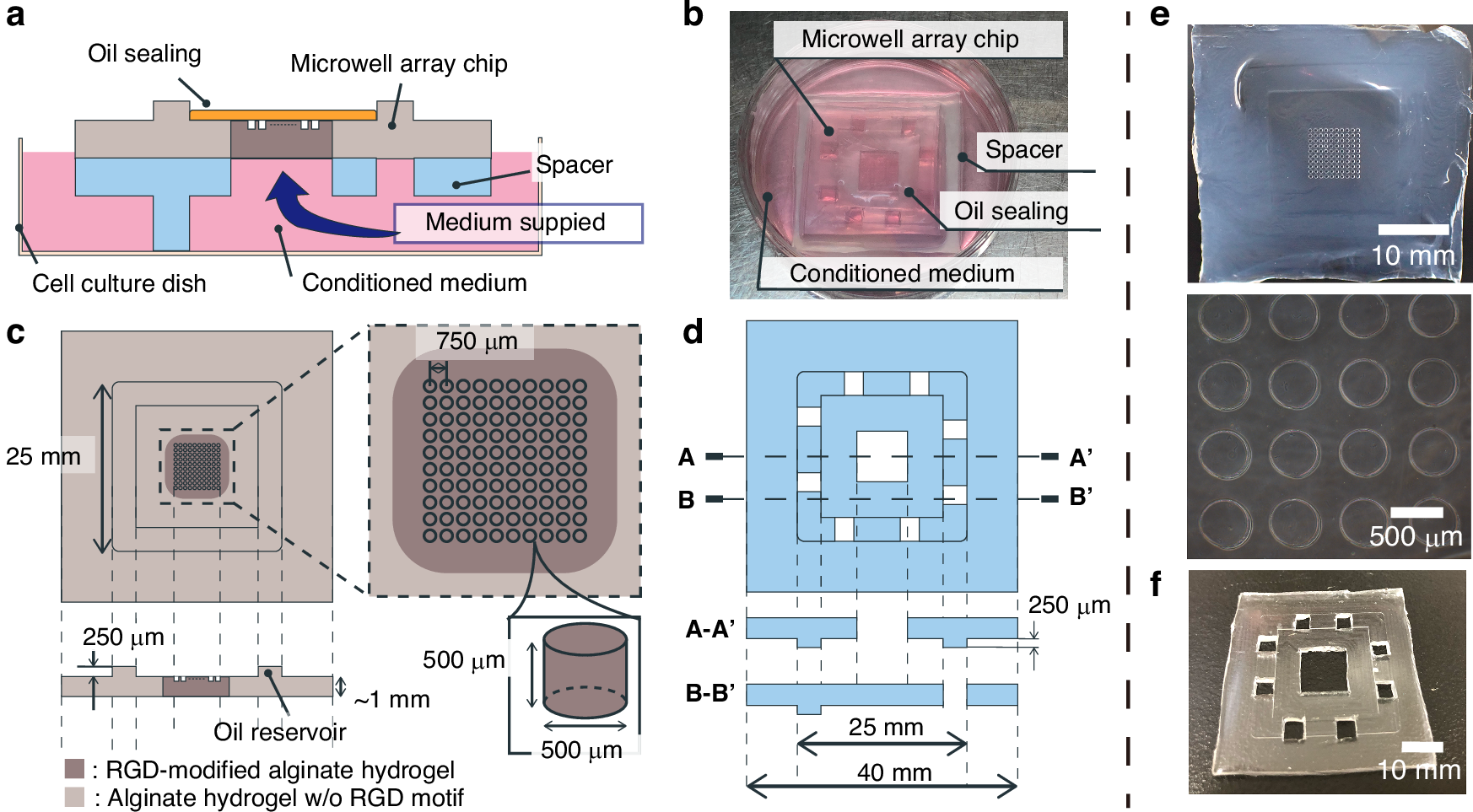
a Cross-sectional image of OSRAH-microwell-array. b Overall view of OSRAH-microwell-array. c Design and material layout of the hydrogel microwell array chip. d Spacer design. Section A-A’ indicates the position with two protrusions supporting spacer, while section B-B’ indicates the position with one protrusion. e Fabricated hydrogel microwell array chip. The scale bar of the top and bottom images are 10 mm and 500 µm, respectively. f Fabricated spacer. The scale bar is 10 mm
The team showed that single cells could grow in these enclosed microwells for more than 19 days, which is unusually long for systems that capture cell-secreted particles. Because the EVs stay inside the sealed space, the researchers were able to draw them out using a fine glass capillary and examine the proteins on their surface. These protein patterns can reveal critical information about how each cell communicates and responds to its environment.
This microwell system could help scientists study why cells behave differently in diseases such as cancer, neurodegeneration, and immune disorders. By examining EVs one cell at a time, researchers may uncover hidden cellular diversity that cannot be detected when looking at mixed populations. This higher resolution has the potential to significantly improve our understanding of disease mechanisms.


