 Exosome RNA Exosome RNA Research & Industry News

Researchers from the Université de Toulouse have discovered an innovative way to treat bladder cancer using tiny bacterial extracellular vesicles (bEVs) instead of traditional therapies. Bladder cancer, one of the most common cancers of the urinary system, is often treated with Bacillus Calmette-Guérin (BCG), a therapy that helps activate the immune system to fight tumors. While effective for some patients, BCG can cause strong side effects and doesn’t always prevent cancer recurrence.
The team explored whether naturally produced nanoparticles from Escherichia coli, known as bacterial extracellular vesicles, could provide a safer and more effective alternative. These vesicles are nanosized packages released by bacteria that can interact with the immune system and deliver biological signals.
In their preclinical tests using a rat model of bladder cancer, animals treated with bEVs showed remarkable tumor reduction. About 60% of the treated rats had complete tumor clearance, compared to only 20% in those treated with BCG. Importantly, the bEV therapy triggered strong local immune activation, including an increase in T cells, which are key in attacking cancer cells.
HlyF OMVs biotherapy induces an efficient reduction of tumour growth in an orthotopic and syngeneic rat model
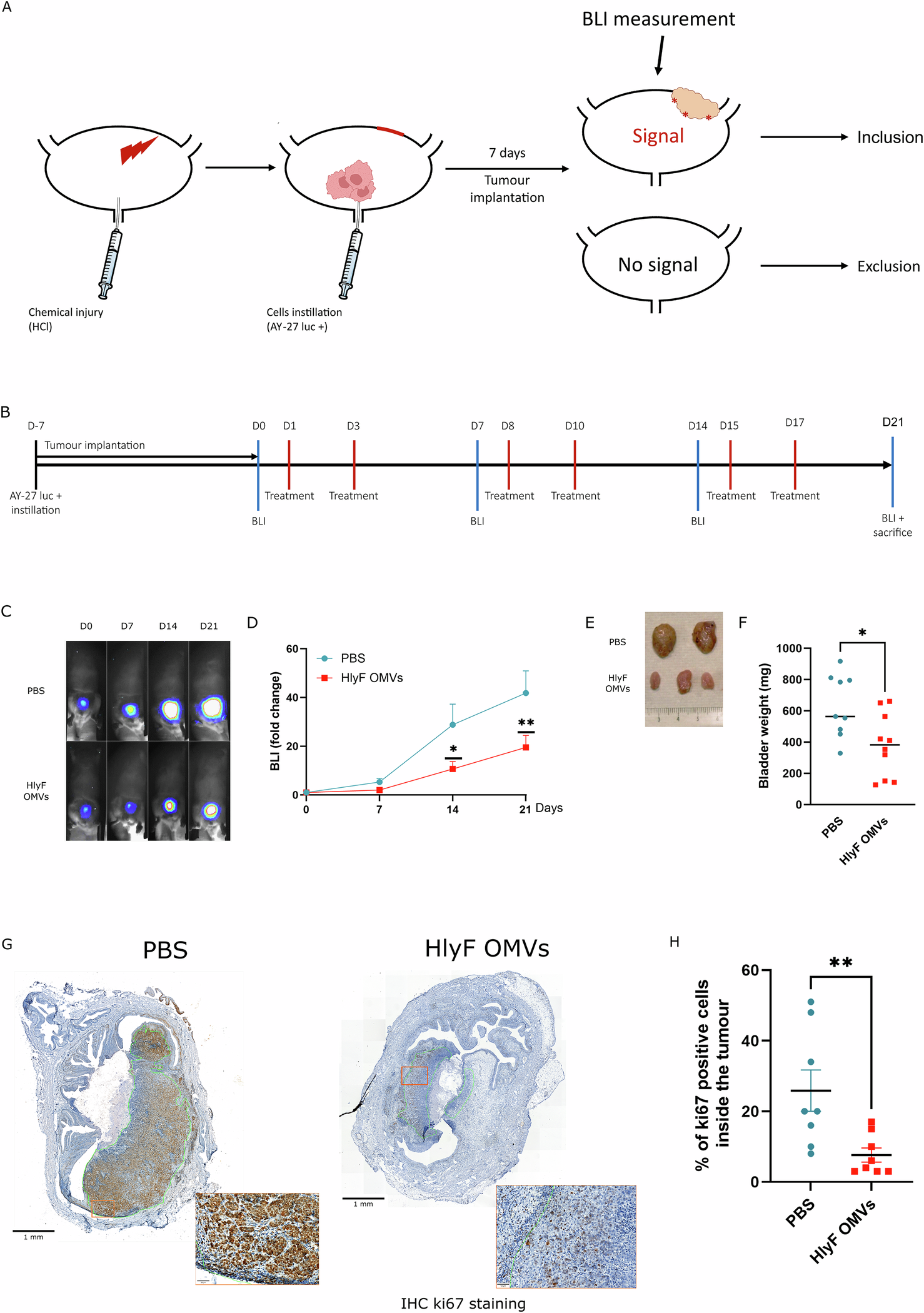
A Orthotopic and syngeneic rat bladder cancer implantation model. A catheter was inserted into the rat bladder, the urothelial epithelium was chemically injured, and AY-27 luciferase + (AY-27 luc+) cells were immediately implanted. After 7 days, BLI was measured, and the rats were randomized into groups so that the mean BLI in each group was equivalent at the start of the experiment. B Experimental design for the assessment of the efficacy of biotherapies. Seven days before the start of the experiment, rats have been implanted with cancerous bladder cells. On day 0, BLI measurement was performed. Rats were then randomized and treated twice a week for 3 weeks (days 1, 3, 8, 10, 15 and 17 in red) either with PBS or HlyF OMVs (1 mg). BLI was measured every week (in blue). Bladders were collected and weighed at the end of the experiment. C Representative images of bioluminescence (BLI) imaging tumours at different timepoints. D In vivo growth curves measured by BLI (fold change relative to D0) at D7, D14 and D21 of AY-27 luc+ tumours treated either with PBS (blue circles) or HlyF OMVs (red squares). Arrows indicate treatment days. Graph shows mean and standard error of the mean (SEM) for each condition. Two-way ANOVA and Sidak’s multiple comparison tests were performed. P-value: *0.0261; **0.0039. E Representative images of bladders at D21. F Bladder weight (in mg) at D21. Each point corresponds to a single rat of the control group (blue dots) or to the HlyF OMVs treated group (red squares). Bars on the graph represent the median for each condition. Mann–Whitney test was performed. P-value: *0.0234. G Representative images of Ki67 immunohistochemical staining on rat bladder sections treated with PBS or HlyF OMVs. Tumours are outlined in green. Scale bar represents 1 mm. Orange rectangles represent enlarged tumour area. Scale bar represents 50 µm. H Quantification of the number of Ki67-positive cells relative to the total number of cells in the tumour using QuPatph software. Each data point represents a single bladder section analysed after treatment with either PBS (blue circles) or HlyF OMVs (red squares). Graph shows mean and SEM for each condition. Mann-Whitney test was performed. P-value: **0.0053.
Equally encouraging was the safety profile, bEVs caused no mortality or systemic toxicity, making them a potentially gentler yet powerful alternative to existing treatments. The findings suggest that bacterial extracellular vesicles could represent the next generation of bladder cancer immunotherapies, harnessing bacterial biology for patient benefit.


