Exosome RNA Exosome RNA Research & Industry News

Cells constantly communicate with each other, and one important way they do this is by releasing tiny packages called extracellular vesicles, often referred to as exosomes. These vesicles are loaded with proteins, RNA, and lipids and can travel to other cells, where they influence how those cells behave. Because of this, extracellular vesicles have attracted strong interest as potential tools for therapy.
Researchers at the Université d’Angers take a close look at what happens when extracellular vesicles interact with recipient cells. While scientists already understand a great deal about how these vesicles are formed and released, much less is known about how they are taken up by target cells and what happens to their cargo afterward.
Composition of extracellular vesicles and functional roles of their components
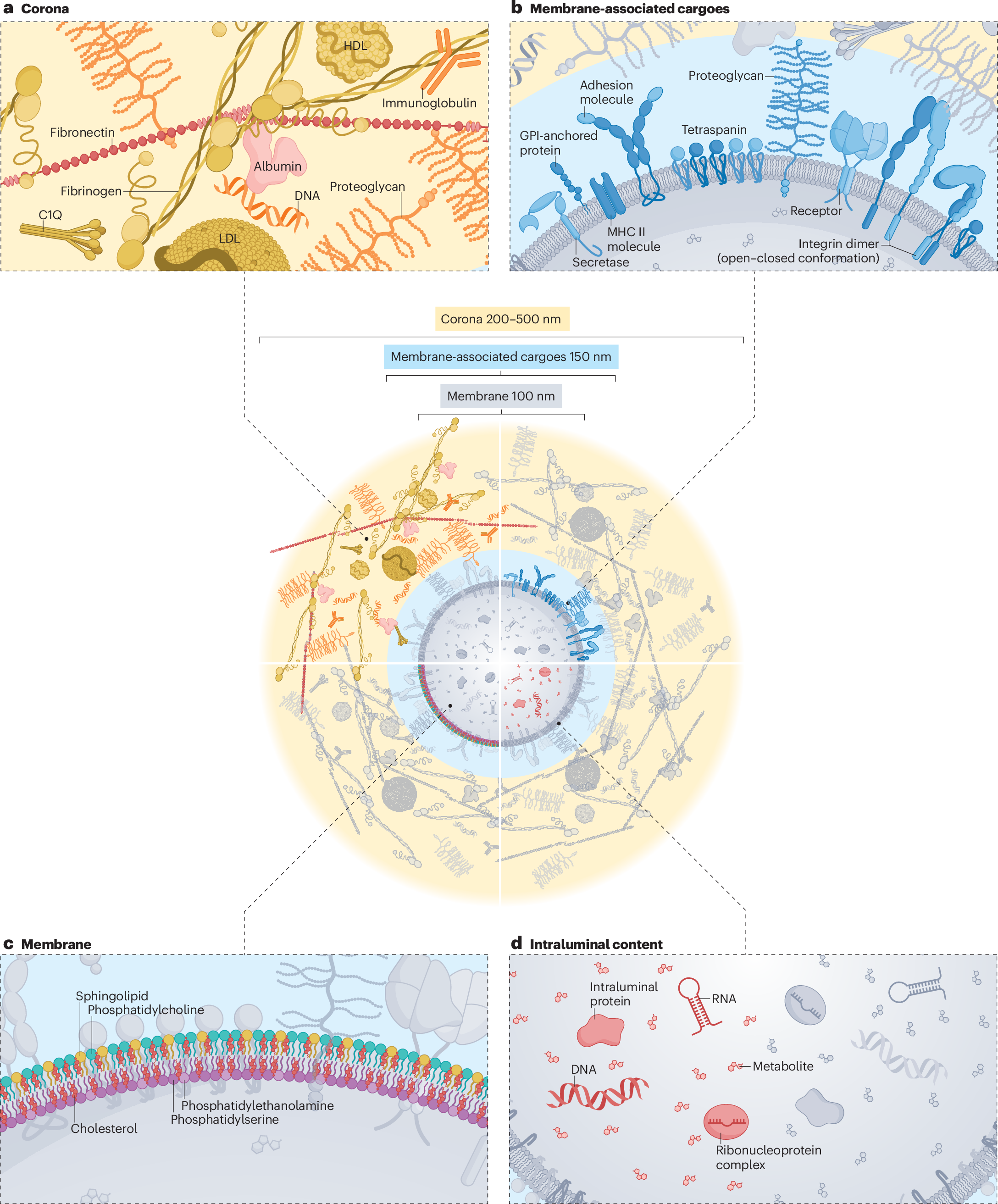
Four distinct layers can be identified in extracellular vesicles (EVs), which are shown in the following schematic, in which we have endeavoured to maintain the relative scale of each component as accurately as possible. a, The corona (shown here as a yellow halo) represents the outer layer that can reach up to 400 nm and is acquired once the EVs are released into the extracellular environment. It contains different proteins, such as albumin, fibronectin or proteoglycan, immunoglobulins, complement component 1q (C1Q) and lipoproteins (HDL and LDL) and also various amounts of nucleic acids such as cell free DNA. b, Beneath the corona, specific sets of membrane-associated proteins, which are often glycosylated (shown here only for proteoglycans although most EV-associated proteins are thought to be glycosylated), mediate EV binding and signalling with recipient cells (represented by a blue halo). Important examples include integrins and adhesion molecules that regulate some targeting features of EVs and receptors or major histocompatibility complex (MHC) molecules for signalling capacities. c, These proteins are organized within a lipid bilayer. The lipid composition of EVs, although reminiscent of the producing cell type, is distinct from the lipid composition of the plasma membrane and displays enrichment in lipids, providing structural support to cluster receptors or ligands to favour specific binding to recipient cells. d, The membrane encloses and protects soluble elements that can be delivered to recipient cells upon fusion with recipient membranes or degradation in lysosomes. These proteolipid compositions are cell-type-dependent and EV subpopulation-dependent, and EVs are thought to contain intraluminal proteins, nucleic acids and metabolites. GPI, glycosylphosphatidylinositol.
The researchers explain that extracellular vesicles can recognize and bind to specific cell types using molecules on their surface, much like a key fitting into a lock. Once attached, vesicles may enter cells through several pathways, including endocytosis, and their cargo can then trigger signaling pathways or directly change cell function. These processes allow vesicles to act as powerful messengers between cells in tissues such as the immune system and the nervous system.
Importantly, they highlight major challenges that still limit the use of extracellular vesicles as therapeutic delivery vehicles. These include controlling where vesicles go in the body, ensuring efficient cargo delivery, and understanding how vesicles are processed once inside cells. By clarifying the molecular details of vesicle targeting, uptake, and intracellular fate, the authors outline how future therapies could harness exosomes more effectively to deliver drugs or genetic material with high precision.