 Exosome RNA Exosome RNA Research & Industry News

Extracellular vesicles (EVs) released by mesenchymal stem cells (MSCs) are emerging as powerful tools in regenerative medicine. These nanosized packages can deliver therapeutic molecules, reduce inflammation, and promote tissue repair. However, their clinical use has been limited because traditional production methods depend on donor cells, which can be inconsistent and difficult to scale up.
To address this, a team led by researchers from Allife Medicine Co developed a new biomanufacturing strategy that generates MSCs from extended pluripotent stem cells (EPSCs). Using advanced suspension and fixed-bed bioreactors, they created a continuous, automated process that produces large amounts of EVs with consistent quality.
Scalable expansion and characterization of iMSCs in bioreactors
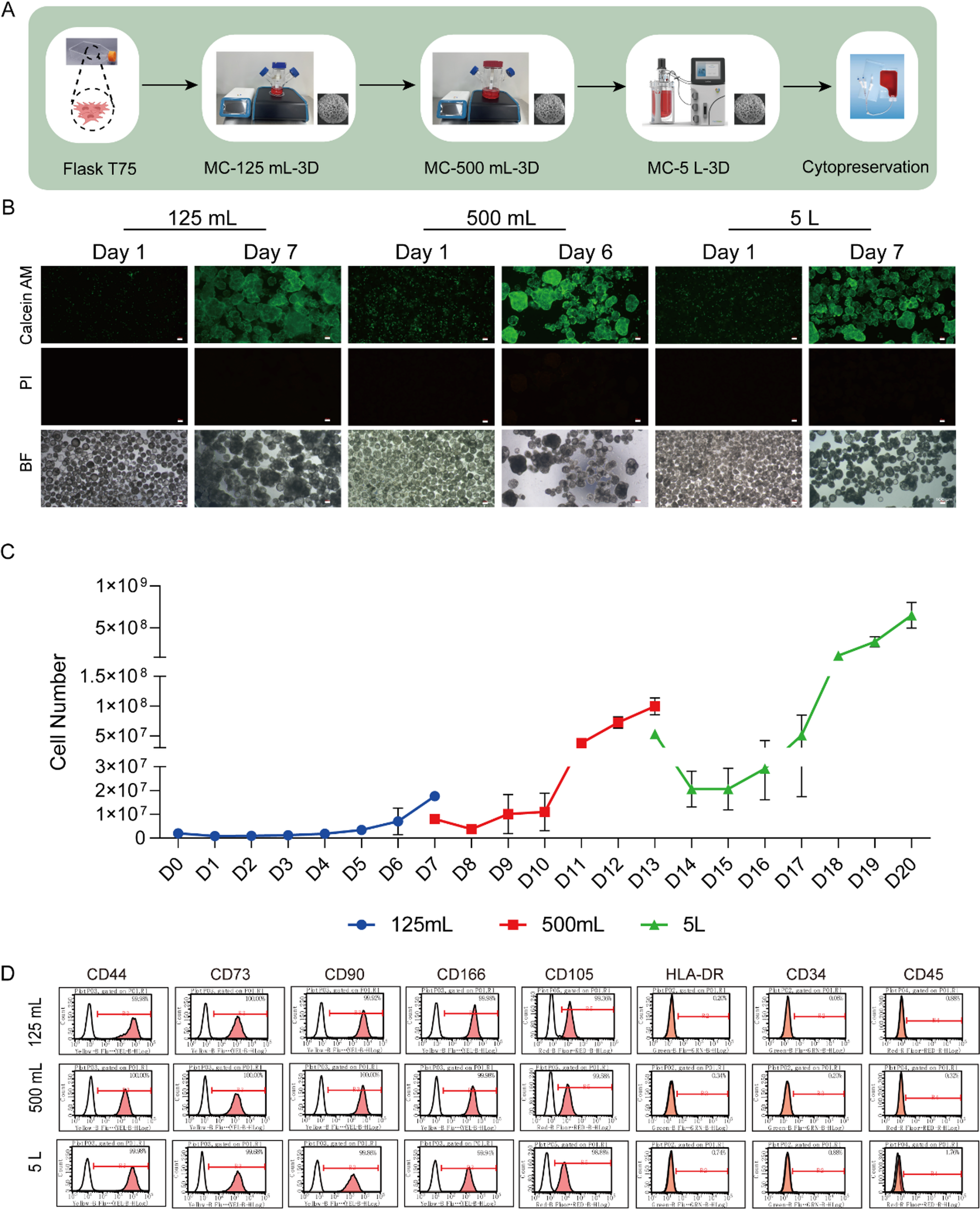
(A) Schematic representation of the stepwise expansion of iMSCs using degradable microcarriers in scalable bioreactor systems. iMSCs were first expanded in a 125 mL bioreactor, followed by sequential scale-up in 500 mL and 5 L bioreactors, with final cell harvesting and cryopreservation. (B) Cell viability assessment using Calcein AM and propidium iodide staining in 125 mL, 500 mL, and 5 L bioreactors at different time points (Day 1 and Day 7 for 125 mL and 5 L; Day 1 and Day 6 for 500 mL). Live cells fluoresce green (Calcein AM), while dead cells fluoresce red (PI). Bright-field (BF) images show the formation of dense 3D cell aggregates over time. Scale bar: 100 μm. (C) Growth curve tracking total iMSC numbers over time in 125 mL, 500 mL, and 5 L bioreactors. iMSCs exhibit an initial adaptation phase, followed by exponential expansion onward, with the 5 L bioreactor achieving the highest cell yield by day 20. Data are presented as mean ± SD, n = 3. (D) Flow cytometry analysis of MSC-specific markers and hematopoietic markers in iMSCs expanded in 125 mL, 500 mL, and 5 L bioreactors. Cells maintain high MSC marker expression and low hematopoietic marker expression across all conditions, confirming the retention of MSC identity after bioreactor expansion
The resulting induced MSC-derived EVs (iMSC-EVs) shared the same size, structure, and biological markers as those from traditional MSCs. Importantly, when tested in a mouse model of lung fibrosis, these iMSC-EVs reduced lung damage and improved recovery, showing similar therapeutic effects to natural MSC-EVs.
This scalable system not only solves key challenges in EV production but also sets the foundation for fully automated, clinically compliant manufacturing of EV-based therapies. With standardized approaches like this, extracellular vesicles could become a reliable treatment option for conditions such as fibrosis and other chronic diseases.


