Exosome RNA Exosome RNA Research & Industry News

Cancer cells constantly alter the way they produce and use energy to support their rapid growth. These metabolic changes can provide valuable clues about how aggressive a tumor is and how it may respond to treatment. However, measuring cancer metabolism typically requires invasive tissue biopsies, making it difficult to monitor patients over time.
Researchers from the National University of Singapore developed a new nanotechnology platform called ACTIVE that can analyze the metabolism of cancer cells using extracellular vesicles found in patient body fluids. Extracellular vesicles, often called EVs, are tiny membrane-bound particles released by cells that carry proteins, lipids, RNA, and metabolites reflecting the condition of their cells of origin.
The ACTIVE platform uses specially engineered catalytic nanomaterials that work together with biological enzymes to detect metabolites carried by extracellular vesicles. By carefully arranging the catalytic components to allow efficient electron transfer, the researchers created a highly sensitive detection system that was more than 30 times more efficient than conventional catalysts.
ACTIVE platform for multiplexed profiling of EV metabolites
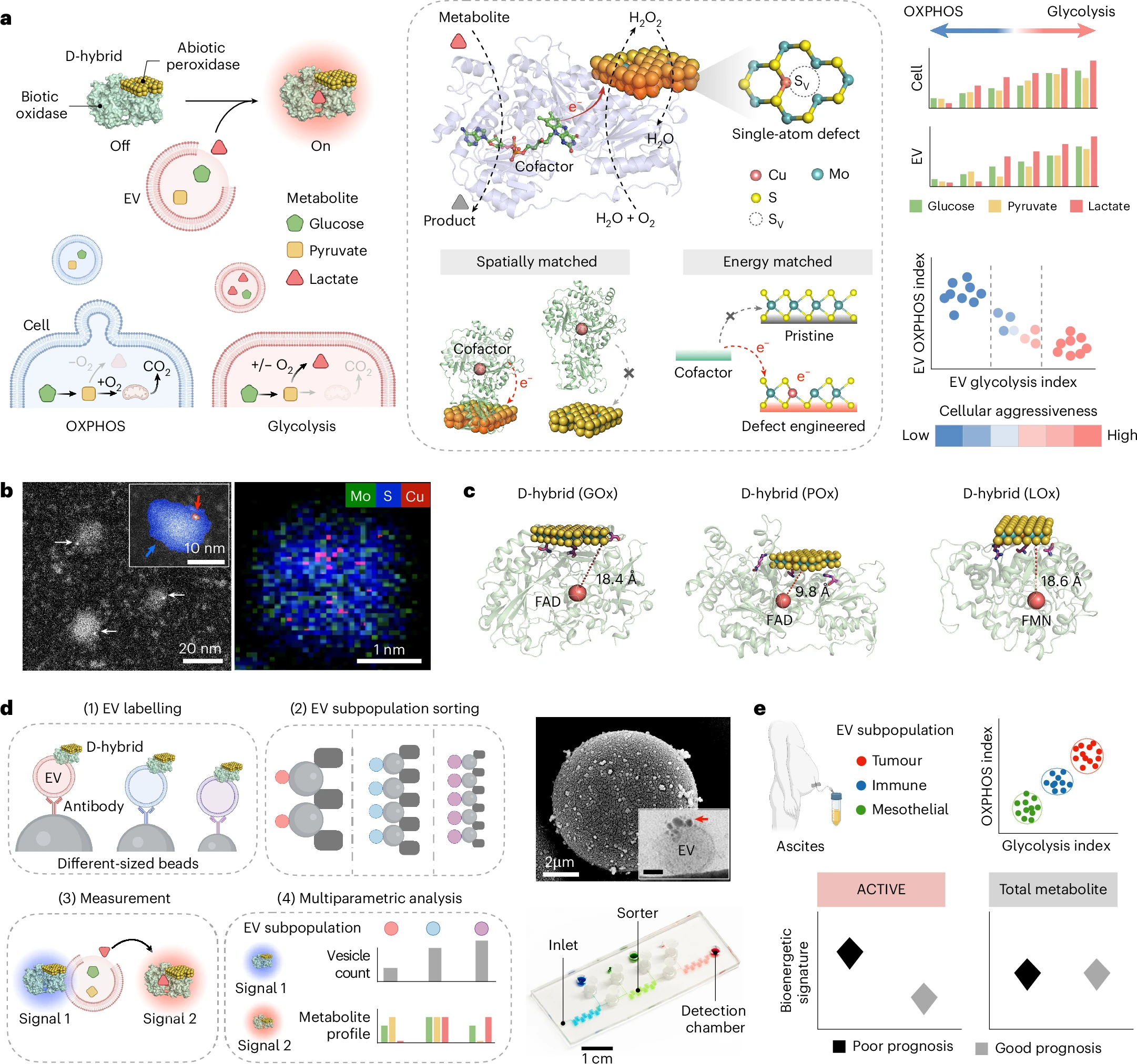
a, ACTIVE schematics. b, Characterization of a D-hybrid (GOx–Cu0.2MoS2). Left: scanning transmission electron microscopy (STEM) image of D-hybrid. c, Programmable D-hybrids. d, Microfluidic device. Left: assay schematics comprising four key steps: (1) EV subpopulations derived from different cells of origin are immunocaptured onto different-sized microbeads and extensively labelled with D-hybrids, (2) bead-bound EV subpopulations are sorted, (3) in situ measurement of D-hybrid labelling (signal 1) and metabolite-induced catalysis (signal 2) and (4) multiparametric analysis of the two signals to characterize vesicle count and metabolite composition of each EV subpopulation. Top right: scanning electron microscopy of EVs captured on a microbead. Inset: high-resolution transmission electron microscopy of EV labelled with D-hybrids (red arrow; scale bar 50 nm). Bottom right: photograph of the microfluidic device. e, Clinical application. ACTIVE was applied for metabolic profiling of different EV subpopulations (for example, derived from tumour, immune and mesothelial origins) directly in cancer ascites. As compared with total metabolite measurements, ACTIVE could effectively distinguish patient prognosis.
One of the most impressive aspects of the technology is its ability to detect extremely small amounts of metabolites directly from native biological fluids. The researchers demonstrated that ACTIVE improved extracellular vesicle metabolic profiling by more than one thousand fold compared with previous approaches. This sensitivity makes it possible to analyze patient samples without extensive preparation or large sample volumes.
The platform also measures a broad range of metabolites across different extracellular vesicle populations. Because these metabolites change as cells alter their metabolism, ACTIVE can monitor dynamic biological processes, including cellular reprogramming and changes occurring within the tumor microenvironment.
To evaluate its clinical potential, the researchers analyzed just 5 microliters of ascites fluid collected from cancer patients. The extracellular vesicle metabolic profiles revealed distinct patterns of metabolic reprogramming that correlated with patient prognosis. These metabolic signatures allowed patients to be separated into different prognostic groups, demonstrating the potential value of extracellular vesicle metabolite profiling as a minimally invasive diagnostic tool.
The findings highlight the growing importance of extracellular vesicles as biomarkers for cancer. While many extracellular vesicle studies focus on proteins or RNA, this work expands the field by showing that metabolites carried by EVs also contain valuable biological information. Combining advanced nanotechnology with extracellular vesicle analysis could provide clinicians with a new way to monitor tumor metabolism, evaluate disease progression, and guide personalized treatment decisions using only a small volume of patient biofluid.
Although additional clinical validation will be needed, ACTIVE represents an important advance toward noninvasive cancer diagnostics. By enabling comprehensive metabolic profiling of extracellular vesicles, the technology may improve cancer detection, prognosis, and treatment monitoring while reducing the need for invasive biopsies.