 Exosome RNA Exosome RNA Research & Industry News

Extracellular vesicles (EVs) are tiny particles released by cells that play a crucial role in communication between cells. They carry important biological molecules, such as proteins and RNA, that can reveal a lot about what is happening inside the body. Because of this, EVs are being recognized as powerful tools in the diagnosis, monitoring, and prediction of various diseases. However, isolating these vesicles from blood or other body fluids has been challenging, especially when only a small amount of sample is available.
The Problem with Traditional EV Isolation Methods
Traditional methods for isolating EVs, such as size exclusion chromatography, commercial precipitation reagents, and ultracentrifugation, have their drawbacks. These techniques often require highly skilled operators and can be inconsistent in terms of yield and quality. This makes it difficult for researchers to consistently obtain high-quality EVs, especially when dealing with limited clinical samples.
For example, when isolating EVs from small amounts of blood, current methods struggle to recover enough EVs for analysis, which can limit their usefulness in clinical settings where only small samples are available.
Introducing the NTI-EXO Method
To address these issues, researchers at St. Joseph’s Hospital and Medical Center have developed a new technique called the NTI-EXO precipitation method. This method has proven to be a game-changer in EV isolation, particularly from small clinical samples like blood. One of the most impressive aspects of NTI-EXO is its efficiency—it can recover five times more EVs from blood serum compared to traditional methods. What’s even more remarkable is that it only requires about two drops of blood (roughly 100 µL) to isolate enough EVs for analysis.
A comparison of NTI-EXO experimental conditions for the
efficient recovery of EVs from human and porcine serum
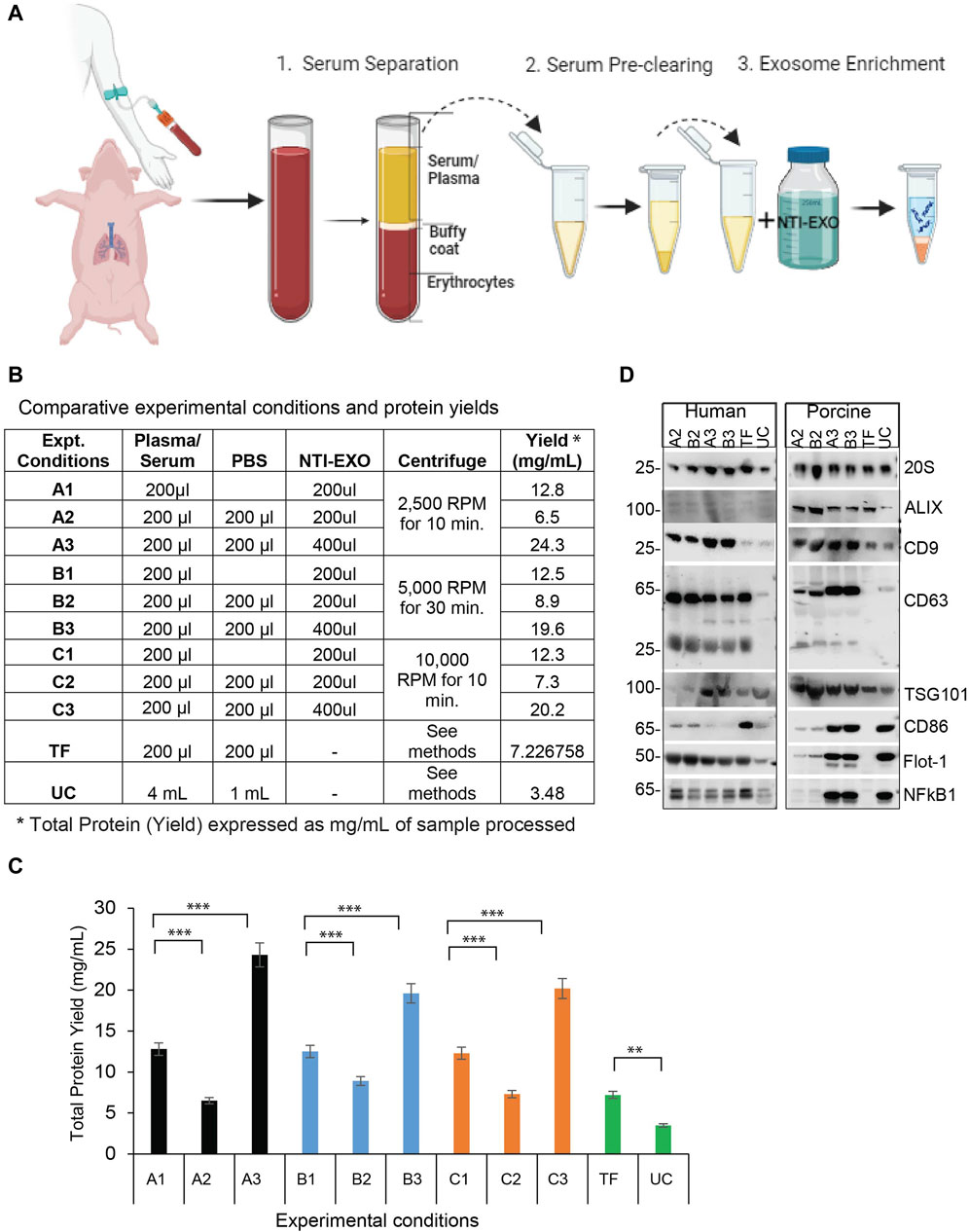
(A) A depiction of the NTI-EXO protocol yielding EVs from human and porcine serum. (B–C) EVs yields isolated from normal human serum from various combinations of NTI-EXO, PBS, and centrifugation speeds. (D) Characterization of human- and porcine-derived EVs using western blot. EVs recovered by NTI-EXO, TF (Thermo Fisher reagent), and UC (ultracentrifugation) were compared. CD9, CD63, CD86, ALIX, 20 s, Flot-1, NFkB1, and TSG101 were analyzed. Some of these markers were better enriched with the NTI-EXO method than commercial or standard (UC) methods. Twenty micrograms of the total protein were used for immunoblotting experiments. Experimental conditions A1-A3, B1-B3 and C1-C3 are individual isolation conditions. Values are given as mean ± S.D. of three independent experiments. Statistical significance was defined at **p < 0.01, and ***p < 0.001 compared to the corresponding control.
Ensuring Quality and Integrity
Quality is a key concern when isolating EVs, as the integrity and purity of these vesicles are critical for accurate analysis. The researchers behind NTI-EXO took this seriously, rigorously testing the EVs they isolated to ensure they were of high quality, free from contaminants, and maintained their proper size.
To validate their method, they successfully used NTI-EXO to isolate EVs from the blood of organ transplant recipients. These EVs were then analyzed for specific disease markers, including LKB1, the SARS-CoV-2 spike protein, and PD-L1, which are important indicators in various diseases, including cancer and viral infections.
The Impact of NTI-EXO on Biomedical Research
The NTI-EXO method is a significant advancement in the field of biomedical research, particularly in the study of EVs. By providing a rapid, user-friendly, and highly efficient way to isolate EVs from small blood samples, this method opens up new possibilities for using EVs in clinical diagnostics and monitoring. It also makes it easier for researchers to explore the potential of EVs in various medical applications, driving forward discoveries that could lead to better treatments and outcomes for patients.
In conclusion, the NTI-EXO method represents a major leap forward in EV research and clinical application. Its ability to reliably isolate EVs from small samples with high efficiency and quality has the potential to revolutionize how we diagnose and monitor diseases, making it an invaluable tool in the ongoing quest to improve human health.


