 Exosome RNA Exosome RNA Research & Industry News

Extracellular vesicles (EVs) are tiny, natural particles released by cells that have shown great promise as delivery vehicles for therapeutic treatments. These vesicles can transport various biological molecules, making them ideal candidates for carrying drugs or other therapeutic agents to specific targets in the body. However, effectively loading proteins into EVs for therapeutic use has been a significant challenge. A recent study by researchers at Northwestern University has made strides in overcoming this hurdle by optimizing how proteins are incorporated into EVs.
How Does It Work?
The study focuses on improving the process of loading proteins into EVs by designing proteins that can better associate with the lipid membranes of the vesicles. Here’s a simplified breakdown of the approach:
- Designing Target Proteins: Scientists engineered proteins to include specific lipid tags. These tags help the proteins attach to the lipid rafts in the plasma membrane of cells. Lipid rafts are specialized areas within the cell membrane that are rich in certain lipids and proteins, and they play a crucial role in various cellular processes.
- Loading into EVs: By attaching these lipid tags to the proteins, the researchers enhanced the proteins’ ability to be incorporated into EVs. This improved the efficiency of loading different types of proteins—both transmembrane (spanning the membrane) and peripheral (attached to the membrane) proteins—into the EVs.
- Functional Delivery: The study demonstrated that these optimized EVs could effectively deliver an engineered transcription factor (a type of protein that helps regulate gene expression) to target cells. This successful delivery allowed the transcription factor to modulate gene expression within the target cells, showcasing the potential of these engineered EVs for functional applications.
EV membrane physical properties and protein content mirror those of lipid rafts
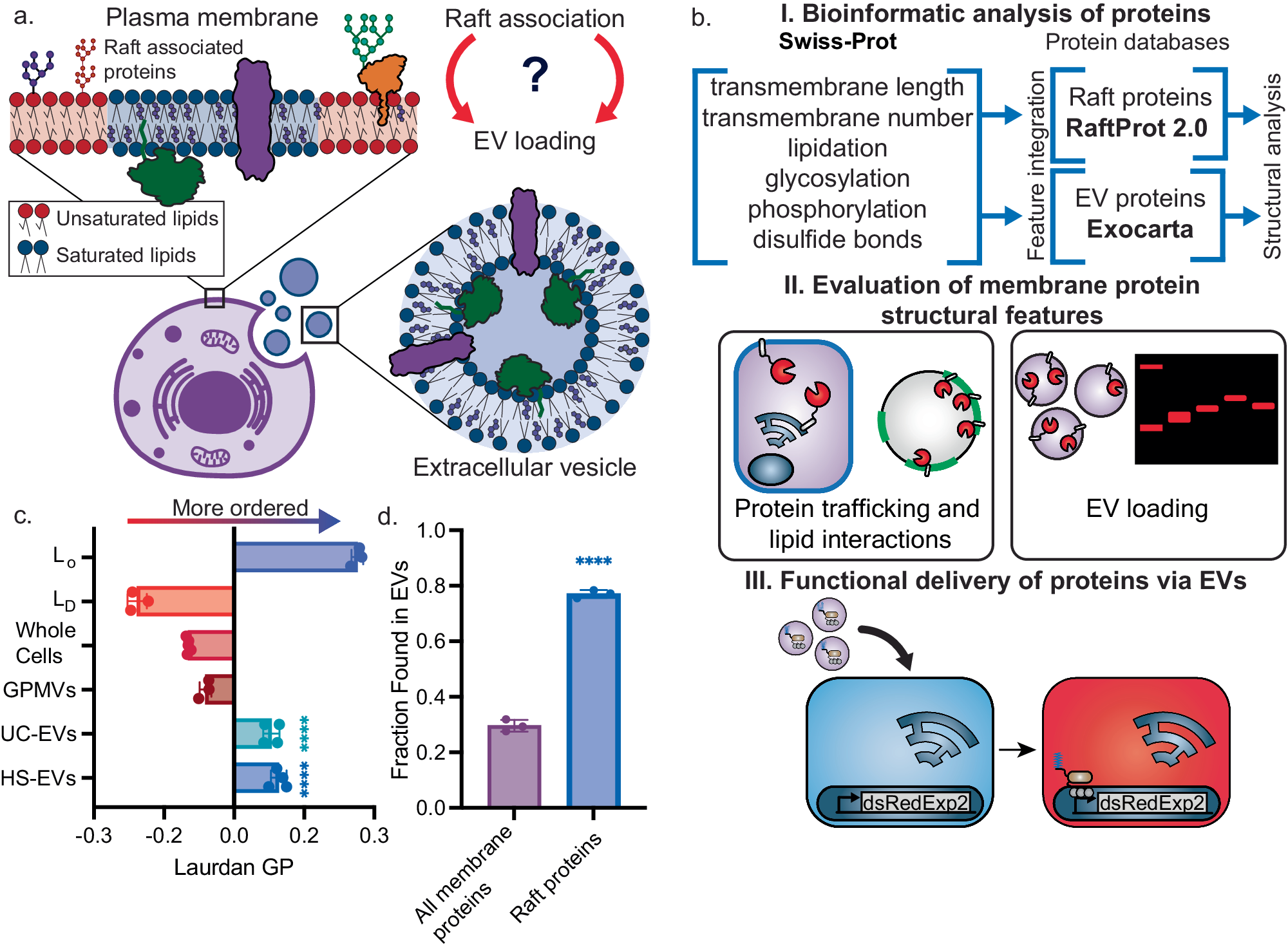
a Schematic of our hypothesis that lipid raft association could be used as a handle to load proteins into EVs. b Overall analysis and experimental workflow. We used RaftProt 2.0 and Exocarta to understand features of proteins found in EVs and lipid rafts (I); we then built a library of structurally diverse proteins to understand how such features affect protein trafficking, interactions with lipid rafts, and loading into EVs (II); applying these design rules, we demonstrate how lipid-protein interactions can be used to functionally deliver cargo to cells via EVs (III). c Laurdan generalized polarization (GP) of ordered liposomes (LO) composed of 70 mol% DPPC/30 mol% Chol, disordered liposomes (LD) composed of 70 mol% DOPC/30 mol% Chol, HEK293FT cells, giant plasma membrane vesicles (GPMVs) and vesicles from the high-speed centrifugation EV fraction (HS-EVs) and ultracentrifugation EV fraction (UC-EVs) derived from HEK293FT cells. HS-EV and UC-EVs had high Laurdan GP, similar to LO membranes as calculated by Eq. 1. Each dot represents an independent experiment (n ≥ 3). A one-way ANOVA was performed to compare the Laurdan GP of HS-EVs and UC-EVs to the Laurdan GP of all other membranes measured, and comparisons were evaluated using the Sidak multiple comparisons correction. Both EV populations were significantly different from all other vesicle populations except one another (****p < 0.0001). d The frequency at which human membrane-associated proteins and raft proteins are found in EVs as calculated via bioinformatic analysis. Raft associated proteins are more frequently found in EVs compared to a random selection of human membrane-associated proteins. Each dot represents a separate query of 100 human proteins (n = 3). An unpaired, two-tailed t-test was performed to compare the fraction of all proteins and raft associated proteins found in EVs. The fraction of raft associated proteins found in EVs was significantly different from the fraction of all proteins (p < 0.0001). n ≥ 3, error bars represent the standard error of the mean (SEM) throughout the figure.
Why Is This Important?
This advancement is significant because it opens up new possibilities for using EVs in therapeutic applications. By improving the ability to load proteins into EVs, researchers can potentially use these vesicles to deliver a wide range of therapeutic proteins, genes, or other macromolecules. This could lead to the development of more effective treatments for various diseases, including those that involve genetic or protein-based therapies.
Future Implications
The ability to engineer EVs to efficiently carry and deliver therapeutic proteins could transform many areas of medicine. This technology could be applied to develop new treatments for genetic disorders, cancer, and other conditions where targeted delivery of proteins or genes is crucial. As researchers continue to refine these techniques, we might see an expansion in the types of therapies that can be delivered using EVs, potentially improving outcomes for patients.
This study highlights an exciting advancement in the field of therapeutic delivery. By enhancing the loading of proteins into EVs, scientists are moving closer to realizing the full potential of these natural delivery vehicles for a wide range of medical applications.


