 Exosome RNA Exosome RNA Research & Industry News

Alzheimer’s disease is one of the most complex and devastating brain disorders, and scientists are still working hard to understand how and why it develops. A recent study led by researchers at the University of Manitoba offers a fresh perspective by turning attention to extracellular vesicles, tiny bubble-like particles released by cells that carry genetic and protein material throughout the body.
These extracellular vesicles (EVs) are like cellular mail carriers. By examining the messages they carry, researchers can learn a lot about what’s happening inside the brain, even from outside the body.
In this study, the team started with a list of 460 genes associated with EVs found in the brain. They analyzed how these genes behave across different biological layers, like RNA (transcriptomics), protein levels (proteomics), and DNA methylation (a kind of genetic “switch”). By combining these datasets, they created personalized risk models to predict how Alzheimer’s disease progresses in different individuals.
Risk model construction workflow
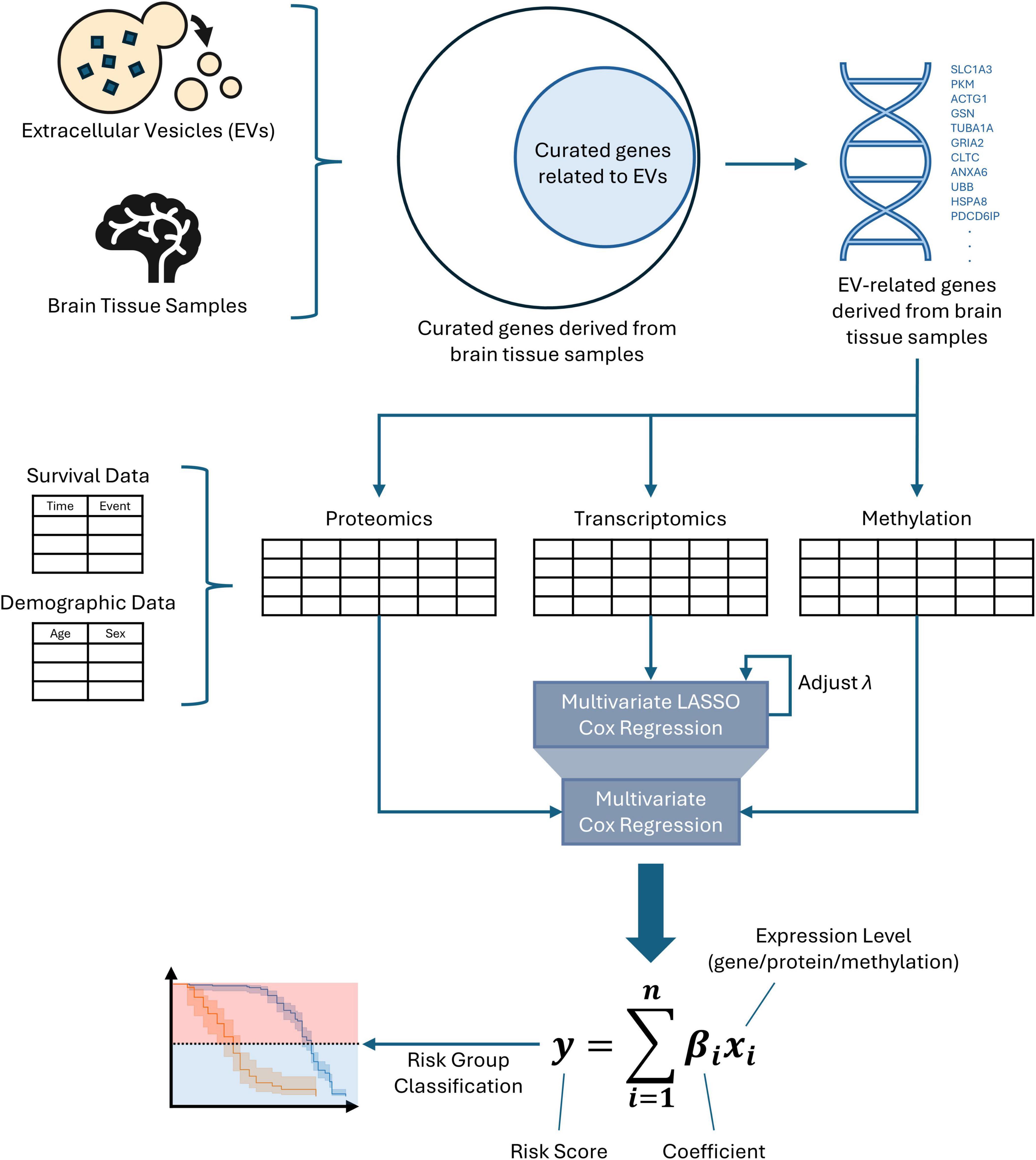
A list of EV-related genes derived from brain tissue samples is used to filter DNA methylation, transcriptomics, and proteomics datasets. Significant gene signatures are selected using multivariable Cox regression with LASSO regularization and combined with demographic data to identify significant risk factors. Scaling coefficients for these risk factors are then calculated using multivariable Cox regression.
Importantly, they found nine genes related to EVs that were strongly linked to Alzheimer’s progression. These genes helped create models that could reliably separate patients into high-risk and low-risk groups. The team also identified key biological pathways, like mitophagy, the process by which cells clean out damaged mitochondria, that seem to play a major role in the disease.
As an exciting bonus, they used a database called the Connectivity Map to identify four existing drugs that might be repurposed to treat Alzheimer’s, based on their influence on the identified genes.
Perhaps most promising of all, the researchers suggest that EVs could eventually be used not just to detect Alzheimer’s risk, but to deliver treatments directly to affected brain cells.
This research highlights a powerful new direction in personalized medicine, where risk prediction, diagnosis, and even drug delivery could all come from analyzing these tiny, but mighty, extracellular messengers.


