 Exosome RNA Exosome RNA Research & Industry News

Exercise benefits tissues throughout the body, but researchers are still working to understand how those benefits are communicated from one part of the body to another. One possible messenger is the extracellular vesicle, or EV, a tiny membrane-bound particle released by cells that can carry proteins, RNA and other biological signals through the bloodstream.
Researchers at the Discovery Center for Musculoskeletal Recovery at the Schoen Adams Research Institute at Spaulding investigated how exercise-related extracellular vesicles influence aging cartilage.
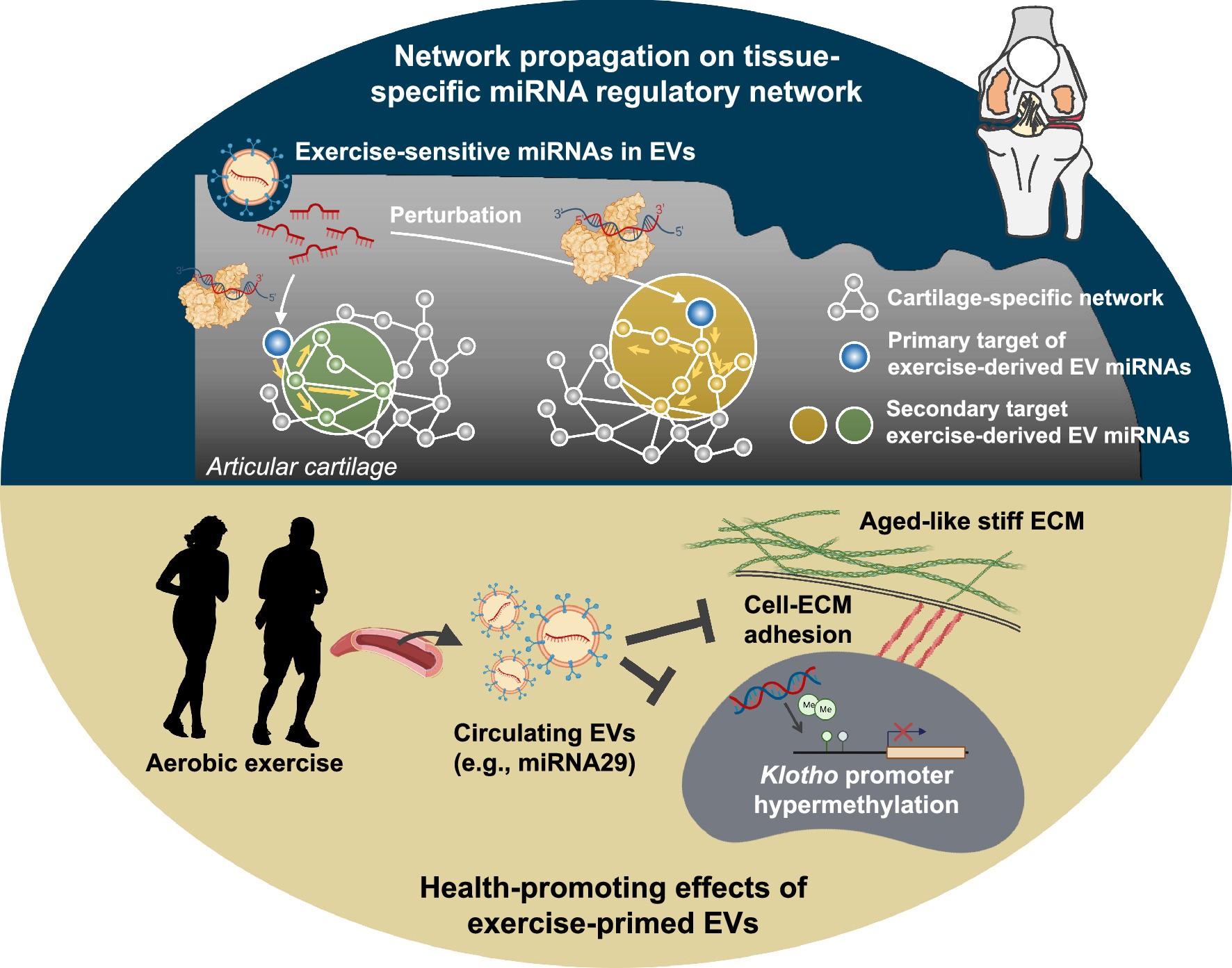
Exercise changes the RNA carried by extracellular vesicles
The researchers focused on microRNAs, small RNA molecules that help regulate gene activity.
Using small RNA sequencing, they found that exercise altered the levels of several microRNAs carried by extracellular vesicles. Computational analysis pointed to the microRNA-29 family as an especially important regulator of pathways related to cartilage aging.
The team then analyzed extracellular vesicles from older adults participating in a three-month aerobic exercise program. After the exercise intervention, the EVs contained higher levels of microRNA-29 compared with EVs collected at baseline.
This suggested that regular exercise can alter the molecular cargo carried by extracellular vesicles circulating through the body.
Helping older cartilage cells behave more like younger cells
The researchers next examined how exercise-primed extracellular vesicles affected chondrocytes, the cells responsible for maintaining cartilage.
Aging cartilage becomes less able to maintain and repair its extracellular matrix. The researchers modeled some aspects of this aging environment in laboratory-grown cells and found that EVs collected after exercise helped restore a more youthful chondrocyte phenotype.
A major part of the response involved the KL gene, which encodes a protein called α-Klotho. Klotho has been associated with longevity and protection against several age-related cellular changes.
The exercise-primed EVs reduced epigenetic suppression of KL, allowing the gene to become more active.
MicroRNA-29 appears to play a central role
To test whether microRNA-29 was responsible for these effects, the researchers engineered extracellular vesicles containing increased amounts of microRNA-29.
These engineered EVs produced many of the same beneficial changes seen with exercise-primed vesicles. The effects depended in part on Klotho, strengthening the connection between EV-carried microRNA-29 and the KL pathway.
This provides a possible biological explanation for how exercise in one part of the body can influence cells in a distant tissue.
Rather than requiring direct contact, cells may package regulatory molecules such as microRNAs into extracellular vesicles that travel through the circulation and alter gene activity in recipient cells.
Testing exercise-primed EVs in aging cartilage
The researchers also tested exercise-primed extracellular vesicles in aged mice.
When these EVs were injected into the joints, the treated animals showed improvements in cartilage health. This provided evidence that the molecular changes observed in cultured cells could also influence cartilage in a living system.
The findings do not mean that extracellular vesicle therapy has been shown to treat osteoarthritis in people. The human portion of the research demonstrated that exercise changes EV microRNA cargo, while much of the direct evidence for cartilage effects came from cell experiments and mice.
How exercise may communicate with distant tissues
Exercise is usually associated with changes in muscles, metabolism and cardiovascular function, but its biological effects extend throughout the body.
Extracellular vesicles may represent one mechanism behind these widespread benefits. By carrying regulatory molecules such as microRNA-29, exercise-primed EVs can potentially deliver molecular instructions to tissues far from where they originated.
The connection between microRNA-29, Klotho and cartilage provides a clearer picture of how that communication may work and offers a potential starting point for investigating new approaches to age-related cartilage degeneration.


