Exosome RNA Exosome RNA Research & Industry News

Chronic wounds are among the most difficult complications of diabetes, particularly diabetic foot ulcers, which can remain open for extended periods despite treatment. Persistent inflammation, poor circulation and cellular damage can interfere with the body’s ability to repair injured skin.
Researchers are increasingly investigating extracellular vesicles, including exosomes, as potential treatments for these wounds. These tiny membrane-bound particles carry proteins, lipids and genetic material between cells, influencing cellular behavior and tissue repair.
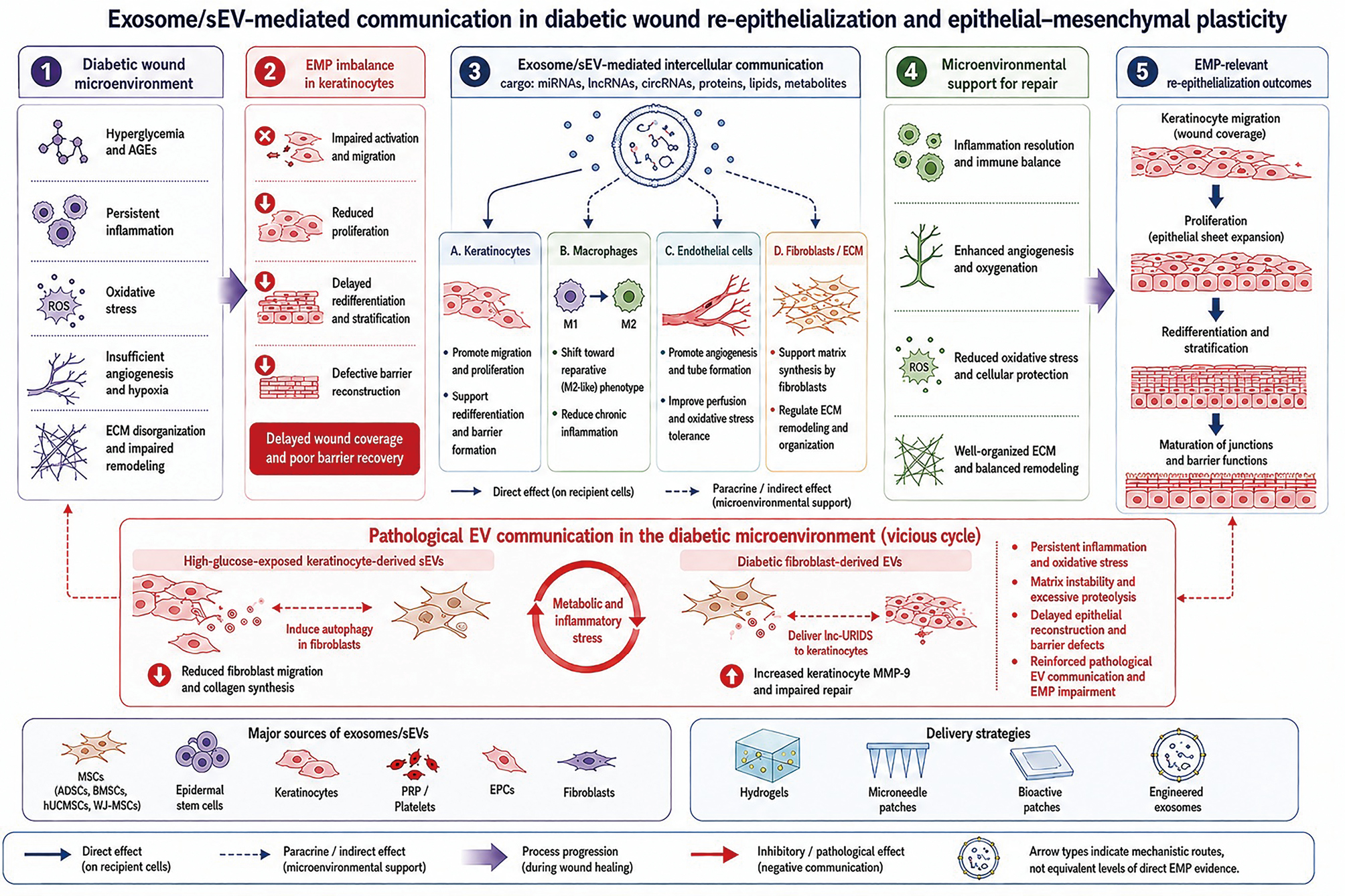
Researchers examined how exosomes and small extracellular vesicles (sEVs) may support diabetic wound healing by helping skin cells migrate, multiply and rebuild the protective outer layer.
Why diabetic wounds are difficult to heal
Normal wound healing involves several coordinated processes, including inflammation control, blood vessel formation and the movement of skin cells across the injured area.
A critical step is re-epithelialization, during which keratinocytes, the primary cells of the outer skin layer, migrate and multiply to close the wound and restore the skin barrier.
In people with diabetes, persistent inflammation, oxidative stress and poor circulation can disrupt these processes. Changes in the extracellular matrix, the network of proteins supporting surrounding cells, can further prevent proper healing.
How extracellular vesicles may support skin repair
Successful wound healing requires keratinocytes to temporarily change their behavior. They must become mobile enough to cover damaged tissue before returning to their normal functions.
This ability to shift between cellular states is known as epithelial-mesenchymal plasticity (EMP). When these transitions become disrupted, wounds may remain open or fail to restore a functional skin barrier.
Exosomes and other small extracellular vesicles may help regulate these processes by delivering molecular signals between cells.
Research suggests that extracellular vesicles can promote keratinocyte migration and proliferation, regulate excessive inflammation, encourage new blood vessel formation and reduce oxidative stress. They may also influence collagen production and extracellular matrix remodeling, creating an environment more favorable for wound repair.
Together, these effects suggest that extracellular vesicles could help address several biological factors that contribute to delayed healing in diabetic wounds.
Important limitations and future applications
Although experimental studies have reported improvements in wound closure following extracellular vesicle treatment, the researchers emphasize that evidence directly connecting these effects to coordinated EMP changes remains limited.
Faster wound closure does not necessarily demonstrate that keratinocytes have returned to their normal identities or successfully restored the protective skin barrier.
The researchers also discuss engineered extracellular vesicles and specialized delivery systems, such as hydrogels and wound dressings, that could improve vesicle stability and retention at wound sites.
However, challenges involving manufacturing consistency, dosing, safety and clinical effectiveness must be addressed before these approaches can become established treatments.
Advancing extracellular vesicle research
The researchers highlights the potential of exosomes and small extracellular vesicles to support diabetic wound healing through their effects on keratinocytes and the surrounding tissue environment.
By focusing on epithelial-mesenchymal plasticity, researchers can better understand whether these treatments simply accelerate wound closure or also support the complete restoration of healthy skin.
These findings provide a framework for developing and evaluating extracellular vesicle-based therapies for diabetic foot ulcers and other chronic wounds.