Exosome RNA Exosome RNA Research & Industry News

Gene therapy has emerged as a groundbreaking approach for treating diseases once considered incurable, including genetic disorders, cancer, and autoimmune conditions. However, one of the biggest challenges in gene therapy is delivering genetic material efficiently and safely to target cells. Traditional methods, such as viral vectors, can introduce immunogenicity and toxicity concerns, limiting their widespread use. Researchers at Harvard Medical School explore the potential of extracellular vesicles (EVs) as a non-viral delivery platform for gene therapy.
Why Extracellular Vesicles?
Extracellular vesicles are small, naturally occurring particles released by cells that play a crucial role in cell-to-cell communication. Unlike viral vectors, EVs are biocompatible, immunologically neutral, and capable of crossing biological barriers. These properties make them an attractive option for delivering gene therapy payloads, including transgenes, small RNA molecules, DNA, and even functional proteins.
Enhancing Gene Therapy with EVs
The review highlights several ways in which EVs can be optimized for gene therapy:
- Inherent Bioactivity – EVs naturally contain proteins and nucleic acids that can support therapeutic effects.
- Cargo Loading – Scientists can engineer EVs to carry specific gene therapy tools, enhancing their effectiveness.
- Targeted Delivery – Modifying the surface of EVs can help direct them to specific cells or tissues.
- Controlled Release – EVs can be designed to release their cargo in response to specific biological signals, improving therapeutic outcomes.
Extracellular vesicles as tools to deliver gene therapy
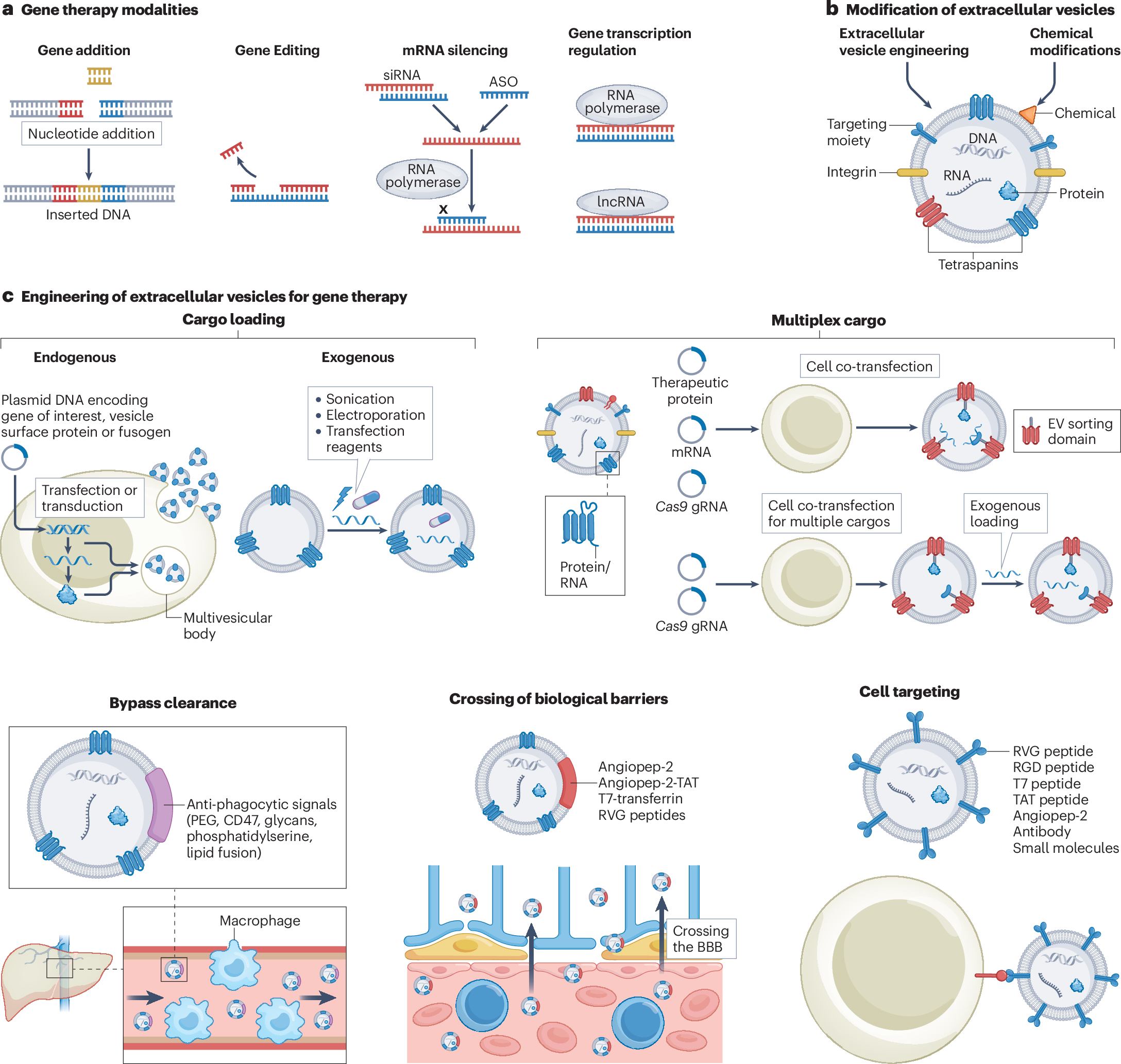
a, Different gene-therapy modalities. b, The trans-membrane proteins of extracellular vesicles can be fused with a tag to carry a therapeutic cargo, or the vesicles can be modified with reactive chemicals linked to a cargo. c, Extracellular vesicles can be loaded with cargo through endogenous (passive loading by cell) or exogenous (active loading) approaches, and they can also carry and release multiple cargos. Multiplex cargos can be added by co-transfecting cells with multiple vectors for different cargos linked to vesicle proteins, or by exogenously loading multiple cargos. The surface of extracellular vesicles can be further modified with anti-phagocytic signals to prevent recognition by immune cells and bypass liver cells to extend their circulation time. Surface modification with angiopep-2 or peptides allows crossing of biological barriers, such as the blood–brain barrier (BBB). Extracellular vesicles can also be engineered to contain targeting moieties to enable delivery of gene therapies to specific cells and tissues. ASO, antisense oligonucleotide; CD47, cluster of differentiation 47; gRNA, guide RNA; lncRNA, long non-coding RNA; siRNA, small interfering RNA; PEG, polyethylene glycol; RGD peptide, Arg–Gly–Asp peptide; RVG peptide, rabies virus glycoprotein peptide; TAT, trans-activator of transcription.
Clinical Applications and Challenges
Researchers are already exploring EV-based gene therapy in clinical settings, particularly for neurological diseases, cancer treatment, and regenerative medicine. However, challenges remain, including large-scale production, standardization of isolation methods, and ensuring precise targeting and efficacy in patients.
The Future of EV-Based Therapies
Extracellular vesicles represent a promising step forward in gene therapy, offering a safer and more versatile alternative to traditional viral vectors. While further research and development are needed to overcome technical and regulatory hurdles, EV-based gene delivery has the potential to transform the landscape of genetic medicine.