Exosome RNA Exosome RNA Research & Industry News

Extracellular vesicles, or EVs, are tiny membrane-bound particles released by cells. They carry proteins, RNA, lipids, and other molecules that can influence the behavior of nearby or distant cells. In bone tissue, EVs released by osteoblasts, the cells responsible for forming new bone, are increasingly being studied for their role in bone repair and regeneration.
Researchers at the University of Zurich have now compared two different extracellular vesicle populations produced by mineralizing osteoblasts.
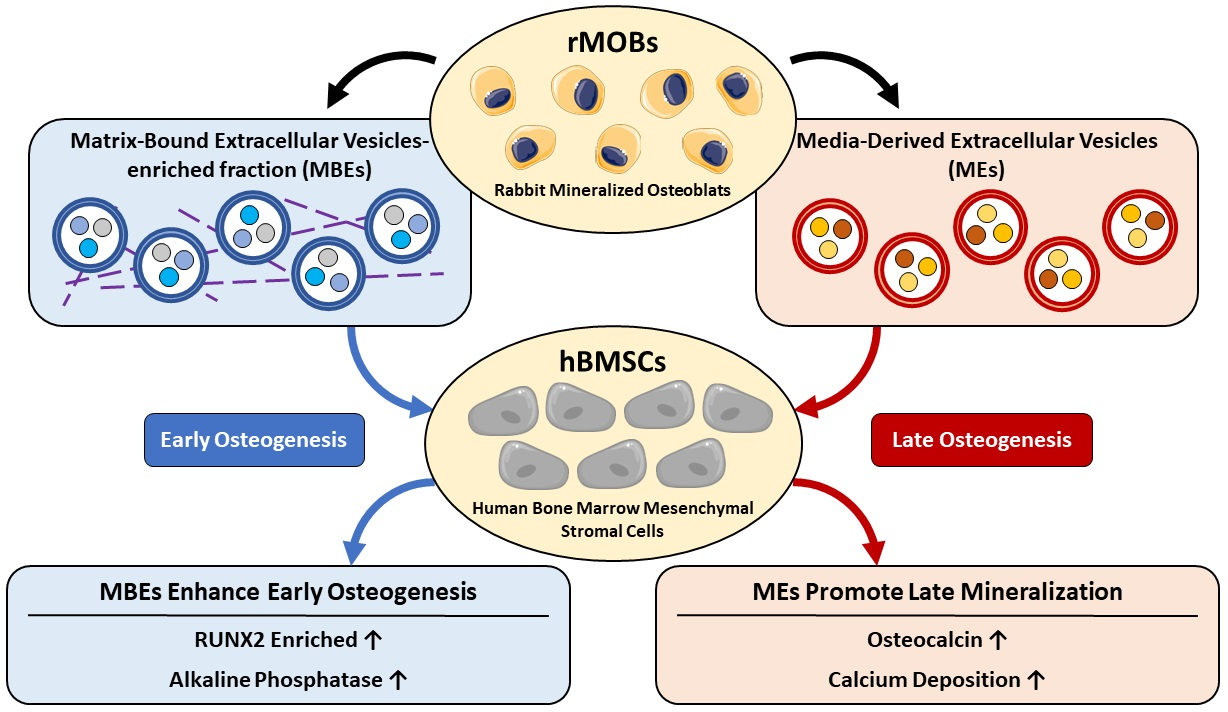
The researchers examined media-derived extracellular vesicles, or MEs, which are released into the surrounding cell culture fluid, and matrix-bound extracellular vesicle-enriched fractions, or MBEs, which are associated with the mineralized extracellular matrix produced by osteoblasts.
Although the two EV preparations were similar in size and abundance, they showed important differences in their molecular contents and biological effects. Most particles measured between 30 and 200 nanometers, and both preparations contained the EV-associated marker CD63.
Different vesicles carry different bone-related signals
The researchers analyzed RNA carried by the vesicles and found that the matrix-bound EV-enriched fractions contained higher levels of RUNX2 mRNA. RUNX2 is an important regulator of osteoblast development and bone formation.
The team then tested how the two EV populations affected human bone marrow-derived mesenchymal stromal cells. These cells can develop into several cell types, including bone-forming osteoblasts.
Both types of extracellular vesicles encouraged the cells to move toward an osteogenic, or bone-forming, state. However, they did so in different ways.
Matrix-bound EV-enriched fractions were associated with higher alkaline phosphatase activity, a marker of early osteogenic differentiation. Media-derived EVs produced greater osteocalcin expression and showed a tendency toward increased mineral deposition under osteogenic conditions.
The location of extracellular vesicles may influence their function
These findings suggest that extracellular vesicles produced by the same osteoblasts are not necessarily biologically identical. Their location, either freely released into the surrounding environment or associated with the extracellular matrix, appears to influence their molecular cargo and their effects on recipient cells.
This distinction could be important for researchers developing EV-based approaches for bone regeneration. Depending on the desired biological effect, freely released EVs and matrix-associated vesicles may offer different advantages.
The researchers also noted that the matrix-bound preparations may contain extracellular matrix components that were collected along with the vesicles. More refined isolation methods will be needed to better define the specific contribution of the matrix-associated EVs.
Overall, the results support the idea that extracellular vesicle activity depends not only on the cells that produce them, but also on the extracellular environment in which they are located. Understanding these differences could help researchers design more effective EV-based strategies for bone tissue engineering and regenerative medicine.