 Exosome RNA Exosome RNA Research & Industry News

Extracellular vesicles (EVs) are small particles released by cells that play a key role in communication between cells, carrying various molecules such as proteins, lipids, and RNA. Recently, EVs have shown great promise as a potential therapeutic tool in regenerative medicine, offering a way to treat injuries or diseases without the need for cell transplantation. However, using EVs derived from primary cell lines, such as those from adult tissues, has challenges, including limited supply, variability between donors, and genetic instability. This is where a new approach involving stem cells comes into play.
In this study, researchers at the Fondazione IRCCS Ca’ Granda Ospedale Maggiore Policlinico explored the use of human induced pluripotent stem cells (hiPSCs) derived from cord blood mesenchymal stem/stromal cells (CBMSCs) as a source of EVs. One of the main benefits of hiPSCs is their ability to be grown indefinitely in the lab, making them an ideal and renewable source of EVs. By reprogramming the CBMSCs, they could generate hiPSCs that not only have an inexhaustible supply but also offer the potential for a more standardized and stable EV production process.
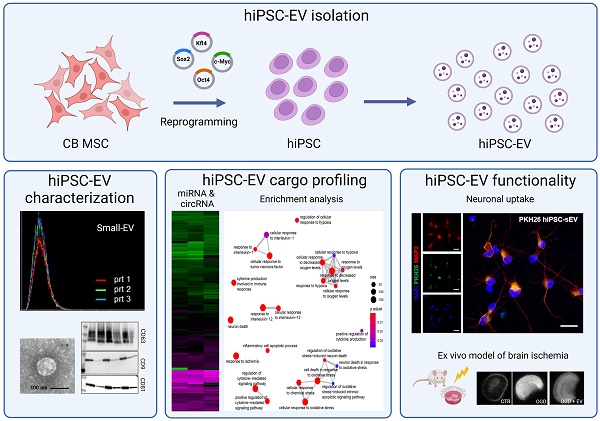
The team carried out a thorough analysis of the EVs produced by these hiPSCs, following strict guidelines to ensure their identity and purity. The results showed that the EVs, referred to as small EVs (sEVs), had the expected physical properties and contained important RNA molecules, including microRNA and circular RNA, which are known to influence cellular functions. These findings are significant because the RNA cargo carried by EVs is believed to play a critical role in their therapeutic effects.
The research also showed that the hiPSC-derived EVs were able to be efficiently taken up by human neurons, suggesting potential applications in treating neurological conditions. Additionally, these EVs exhibited protective properties, helping to shield cells from damage in lab experiments. Bioinformatics tools were used to explore how the RNA cargo inside the EVs might contribute to these beneficial effects, providing deeper insights into the mechanisms at play.
This study highlights the potential of using cord blood-derived hiPSCs as a stable and renewable source of therapeutic EVs. These findings bring us closer to the goal of using EVs in clinical applications, opening up exciting possibilities for treating a range of diseases and injuries, particularly in the field of regenerative medicine. The research demonstrates that stem cell-derived EVs could be a powerful tool for future therapies, offering a promising avenue for healing and regeneration.


