Exosome RNA Exosome RNA Research & Industry News

Extracellular vesicles (EVs) are tiny particles released by cells into the bloodstream, and they come in various shapes and sizes. Think of them as little delivery trucks carrying important molecular cargo like proteins and RNA. Because they are found in many bodily fluids, scientists are excited about their potential for use in diagnosing diseases and developing new treatments. However, the very differences that make EVs valuable also create challenges for their use in medicine.
The Importance of Heterogeneity
The variety in size and composition of EVs is referred to as “heterogeneity.” This diversity can be a good thing: for instance, it can provide useful information for liquid biopsies, a type of test that analyzes blood samples to detect cancer and other conditions. Different types of EVs can carry distinct molecular markers that indicate the presence of specific diseases, making them powerful tools for diagnosis.
However, this heterogeneity can also complicate things. When scientists try to study EVs or use them in treatments, the differences between EV subpopulations can lead to inconsistent results. This inconsistency is one reason why EVs have not yet become widely used in clinical settings, despite their potential.
Addressing the Challenges
In a recent review, researchers at UC Davis explored how the diversity among EVs impacts their functions and effectiveness. They propose several strategies to tackle the challenges posed by this heterogeneity:
- Identify Key Biomolecules: By focusing on the specific molecules within different types of EVs, researchers can better understand how these particles work and what makes them effective in different contexts, such as cancer treatment or wound healing.
- Advanced Analytical Techniques: The use of modern analytical platforms that can analyze individual EVs at a particle level allows scientists to distinguish between the various subpopulations. This precision can lead to a clearer understanding of which EVs are most useful for specific applications.
- Engineering Artificial Nanovesicles: With a better grasp of how natural EVs function, scientists can create artificial vesicles that mimic their properties. These engineered vesicles could be tailored for specific therapeutic uses, effectively harnessing the benefits of EV heterogeneity while minimizing its drawbacks.
Engineering ANVs to address long-standing challenges that are associated with EVs
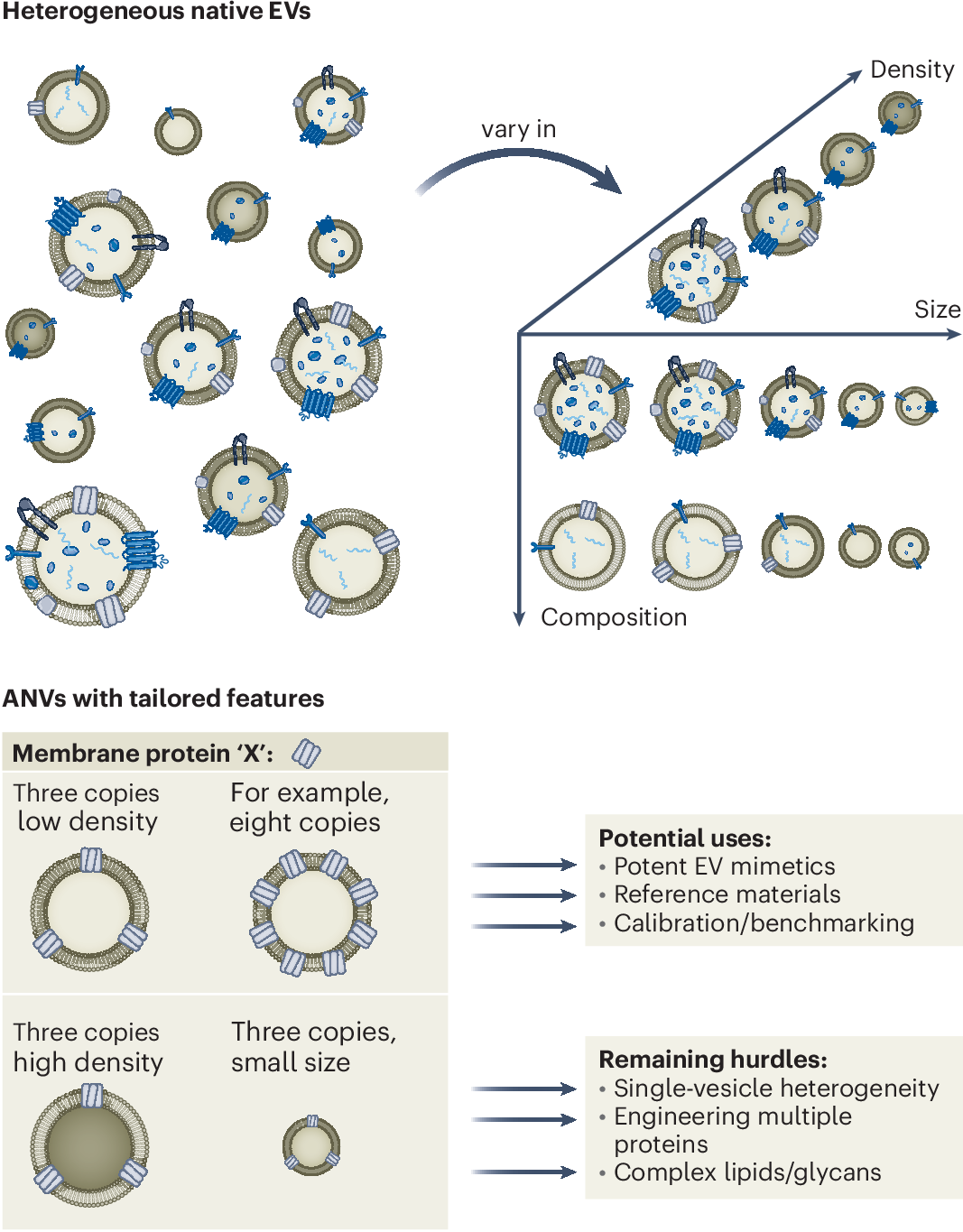
A third cornerstone for addressing inherent EV heterogeneity is to use synthetic ANVs. Whereas native EVs exist in highly entangled mixed populations that vary in, for example, size, density and molecular composition, ANVs can in theory be tailored with highly controlled molecular content (for example, a desired protein ‘X’), size and density. Whereas such materials could benchmark or replace/complement EV therapeutics, it remains a challenge to assess ANV heterogeneity, and technical capabilities for synthesizing vesicles that match the complexity of native EVs (for example, multiple membrane proteins per vesicle, complex lipid and/or glycan decoration) lag behind.
Conclusion
While the variety found in extracellular vesicles presents challenges, it also holds immense potential for advancing medical science. By understanding and addressing the complexities of EV heterogeneity, researchers aim to unlock new diagnostic tools and therapies for a range of diseases, from cancer to neurodegenerative disorders. This double-edged sword may yet become a powerful ally in the fight for better health outcomes.