 Exosome RNA Exosome RNA Research & Industry News

Extracellular vesicles (EVs) are tiny membrane-bound particles that transport biological molecules and help cells communicate. Although much of the research on extracellular vesicles has focused on human and animal cells, scientists are increasingly investigating similar nanoparticles derived from plants for potential therapeutic and cosmetic applications.Researchers at the Engineering Research Center for Biofluid Biopsy in Seoul, South Korea, in collaboration with Korea University, investigated whether vesicle-like nanoparticles isolated from hemp seeds could support skin health and protect against damage caused by ultraviolet (UV) radiation. Their findings were published in Molecules.
Isolating extracellular vesicle-like nanoparticles from hemp seeds
Plant-derived extracellular vesicle-like nanoparticles (EVNPs) are extremely small structures surrounded by membranes that may contain biologically active molecules. However, isolating these particles from plant tissues can be difficult because plants contain complex mixtures of proteins, fats and other cellular materials.
To address this challenge, the researchers developed a multi-step isolation process combining filtration, electrokinetic capture and tangential flow filtration.
Electrokinetic capture uses differences in electrical charge to help separate nanoparticles from other components, while tangential flow filtration further concentrates and purifies the preparation.
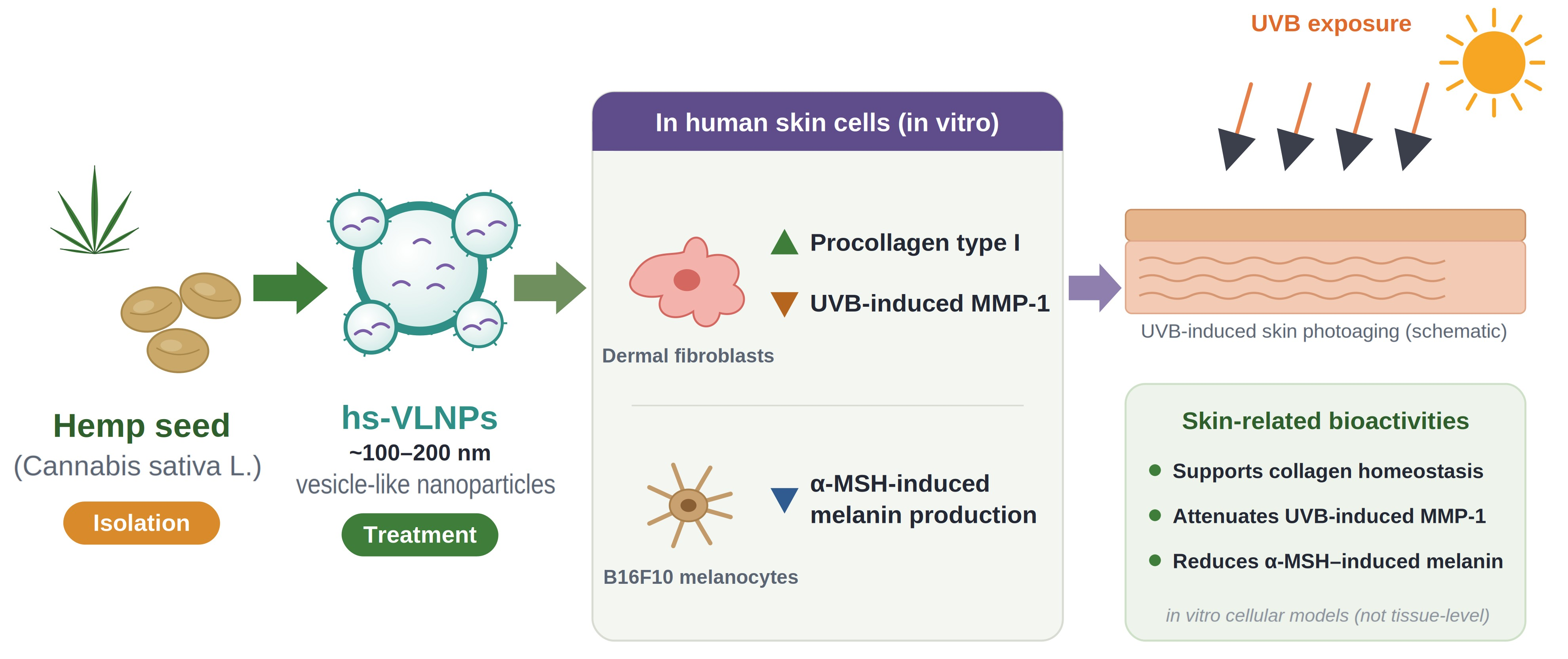
Using these methods, the researchers isolated hemp seed-derived vesicle-like nanoparticles (hs-VLNPs) measuring predominantly 100 to 200 nanometers in diameter.
The nanoparticles displayed membrane-enclosed structures and a negative surface charge, characteristics consistent with vesicle-like particles.
Supporting collagen production and protecting against UV damage
Collagen is an important structural protein that gives skin strength and elasticity. As skin ages or experiences repeated UV exposure, collagen can break down, contributing to wrinkles and other visible signs of aging.
The researchers treated human dermal fibroblasts, cells responsible for producing collagen and maintaining connective tissue, with hemp seed-derived nanoparticles.
They found that the nanoparticles increased production of procollagen type I, a precursor used to form collagen fibers.
The nanoparticles also reduced UVB-induced expression of matrix metalloproteinase-1 (MMP-1), an enzyme that breaks down collagen in the skin.
Together, these findings suggest that hemp seed-derived vesicle-like nanoparticles may help maintain the balance between collagen production and degradation, potentially supporting skin structure following UV exposure.
Effects on wound healing and skin pigmentation
The researchers also investigated whether the nanoparticles could influence other processes involved in skin health.
In laboratory experiments using HaCaT keratinocytes, a commonly studied skin cell line, the nanoparticles improved scratch closure, a method used to measure how effectively cells move into an open area.
This observation suggests that the particles may support cellular migration, an important process during skin repair.
The team also examined their effects on melanin production, the biological process responsible for skin pigmentation.
Hemp seed-derived nanoparticles reduced melanin production stimulated by alpha-melanocyte-stimulating hormone (α-MSH). However, they showed little direct inhibition of tyrosinase, an enzyme involved in melanin synthesis.
These findings suggest that the particles may influence pigmentation through cellular regulatory mechanisms rather than simply blocking melanin-producing enzymes.
Investigating inflammatory response
Inflammation plays an important role in protecting and repairing skin, but excessive or prolonged inflammation can contribute to tissue damage.
The researchers evaluated the nanoparticles in macrophages, which are immune cells involved in inflammatory responses, and human dermal fibroblasts.
They found that the effects varied depending on the cell type and inflammatory molecules measured.
Rather than uniformly suppressing inflammation, the nanoparticles appeared to influence several signaling processes differently.
This suggests that their biological activity is complex and may involve multiple cellular pathways.
Potential applications in skin health
The findings highlight hemp seeds as a potential source of biologically active vesicle-like nanoparticles that influence several processes associated with skin health, including collagen production, cellular migration, pigmentation and inflammatory signaling.
However, the research was conducted primarily using laboratory cell cultures. Additional studies involving more complex skin models and living organisms will be necessary to determine whether these effects translate into meaningful benefits for human skin.
Researchers must also characterize the molecular cargo of these particles and confirm their biological origin. Although they resemble extracellular vesicles, their formation through natural extracellular release has not yet been established.
By demonstrating a method for isolating hemp seed-derived nanoparticles and identifying several biological activities, the research provides a foundation for investigating plant-derived vesicle-like nanoparticles in dermatology, skin repair and cosmetic science.


