Exosome RNA Exosome RNA Research & Industry News

Extracellular vesicles, often shortened to EVs and including exosomes, are tiny particles released by cells that carry proteins, RNA, lipids, and other molecules. Because they naturally move between cells and reflect the state of their cell of origin, EVs have become important tools for studying disease and developing new diagnostics and therapies.
Researchers at Taipei Medical University explore how machine learning is accelerating progress in extracellular vesicle research. EVs are highly complex and diverse, which makes them difficult to analyze using traditional methods. At the same time, modern experiments generate enormous datasets from imaging, sequencing, and molecular profiling. Machine learning provides a way to handle this complexity by finding patterns in large, high dimensional datasets that humans would struggle to interpret on their own.
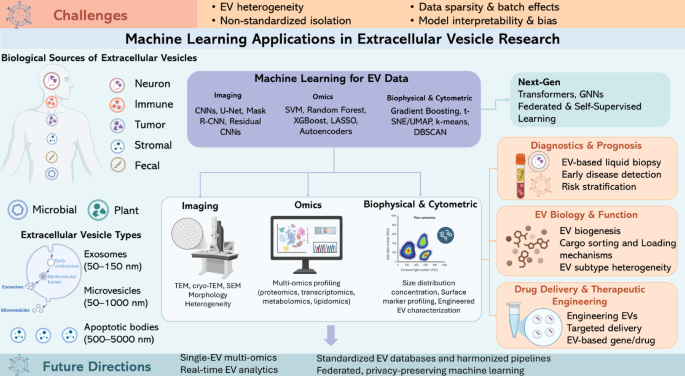
The researchers describe how machine learning approaches are already being used to analyze EV images, classify diseases based on EV profiles, and integrate multiple types of data such as RNA, proteins, and surface markers. Different algorithms are suited to different problems. Convolutional neural networks help extract features from microscopy images, random forests and other classifiers support disease prediction, and autoencoders help reduce noise and uncover hidden structure in complex EV datasets.
Importantly, the researchers introduce a structured framework that links three key dimensions of the field. These are the type of EV data being analyzed, the machine learning method applied, and the clinical goal such as diagnosis, prognosis, drug delivery, or quality control in manufacturing. This unified view helps researchers see how individual advances fit together and where gaps remain.
The researchers also highlight ongoing challenges. EV datasets can be sparse and variable, data collected in different labs may not be directly comparable, and many machine learning models act as black boxes that are difficult to interpret biologically. To address these issues, the authors discuss emerging solutions such as federated learning, self supervised models, and real time EV analytics that can learn from data without compromising privacy or requiring extensive manual labeling.
Overall, the work shows how combining machine learning with extracellular vesicle research is moving the field toward more reliable diagnostics and smarter therapeutic design. By connecting computational methods with EV biology, this approach is helping turn complex data into clinically useful insights for precision medicine.