 Exosome RNA Exosome RNA Research & Industry News

Extracellular vesicles, including exosomes, circulate throughout human blood and act as important messengers between cells. They carry proteins and lipids that reflect physiological states and disease processes, making them attractive targets for biomarker discovery. Despite this promise, the exact molecular composition that defines true extracellular vesicles in plasma has remained unclear, largely because blood also contains many non-vesicle particles that look similar.
Researchers at the Baker Heart and Diabetes Institute, Australia set out to solve this problem by building a detailed molecular map of circulating vesicles in human plasma. Using samples from more than 140 individuals, the team applied high-resolution density gradient fractionation to carefully separate extracellular vesicles from other particles before analyzing them with advanced mass spectrometry.
Hallmark molecular features of circulating EVs
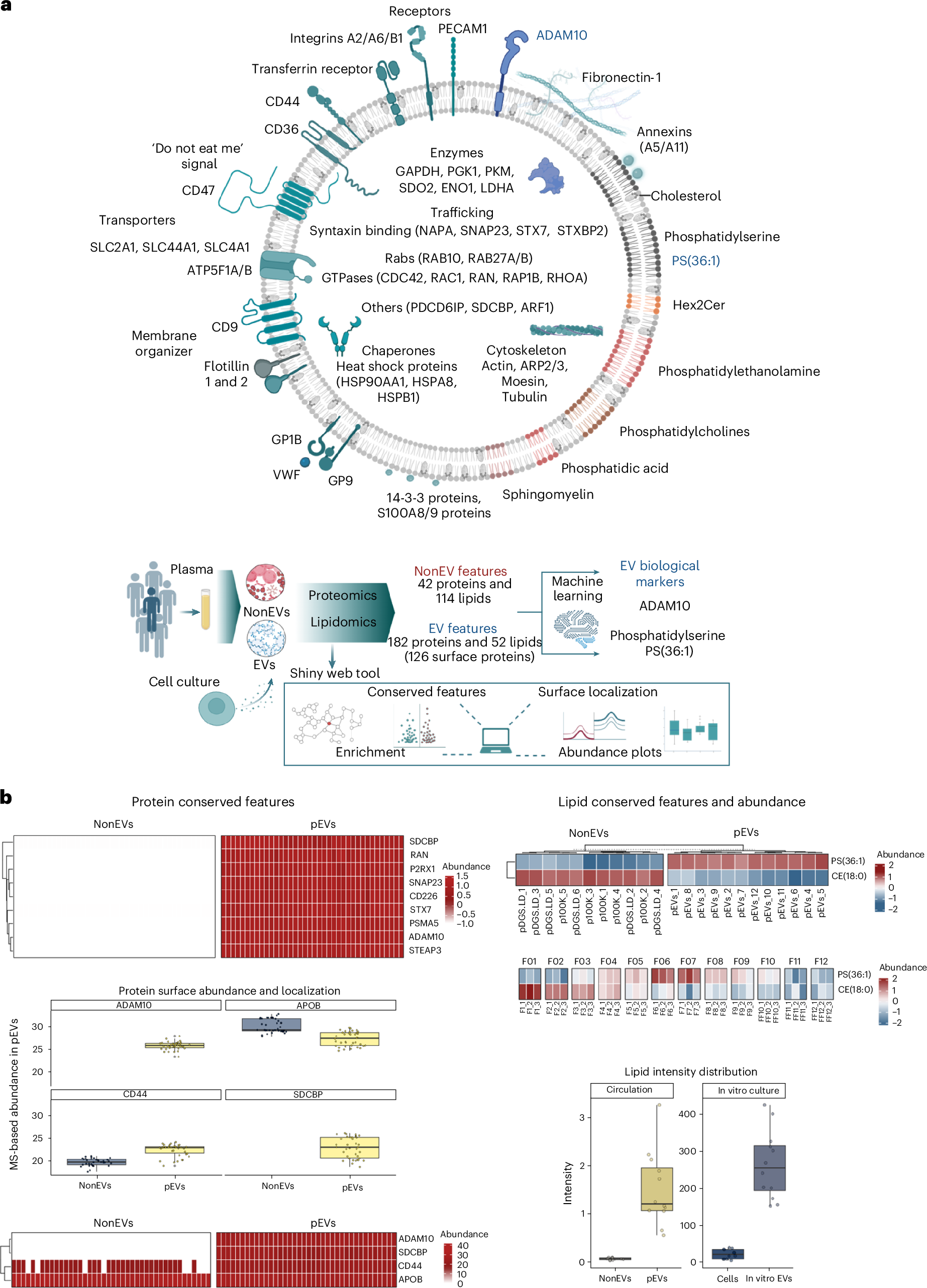
a, Resolving the protein and lipid componentry intrinsic to circulating EVs. These features are also conserved in EVs released by cultured cells. We submit EV features, namely ADAM10 and phosphatidyl serine PS(36:1), as biological markers for confident EV identification and potentially purity assessment. b, The open-source Shiny web tool will facilitate interrogation of protein and lipid features in pEVs and NonEVs and serve as a valuable repository to the research community for a clearer understanding of circulating EV biology. Boxplot show the median (centre line), 25th–-75th percentiles (box) and minima and maxima within 1.5× interquartile range (whiskers); individual data points are overlaid.
This approach allowed the researchers to quantify both the proteome and lipidome of plasma vesicles at unprecedented depth. They identified more than 4,500 proteins and 800 lipid species associated with extracellular vesicles. From these data, the team defined a highly conserved core set of proteins and lipids that consistently appeared across samples. These molecules represent hallmark features of circulating vesicles and are closely linked to vesicle structure, trafficking, and signaling.
Importantly, the researchers also characterized proteins found specifically on the vesicle surface, information that is critical for understanding how extracellular vesicles interact with target cells. In parallel, they identified molecular signatures that distinguish vesicles from non-vesicle particles commonly present in plasma. This enabled them to propose robust markers, including ADAM10 and a specific phosphatidylserine lipid species, that can reliably separate true extracellular vesicles from contaminants.
To make these data broadly useful, the authors created an open-access web tool that allows researchers to explore vesicle-associated proteins and lipids interactively. This resource provides a reference framework for future studies aiming to interpret blood-based vesicle data in health and disease.
Availability – An open-source Shiny web tool is available at: evmap.shinyapps.io/evmap/


