 Exosome RNA Exosome RNA Research & Industry News

In a remarkable development at the intersection of physics, chemistry, and biology, researchers from the University of Texas at Austin have unveiled a new method for assembling nanoscale materials using tiny, precisely controlled microbubbles. Their findings, published in Nature Communications, describe how these microbubbles can be generated in a massively parallel and biocompatible way, enabling the organized placement of microscopic materials like extracellular vesicles (EVs), nanocrystals, and even living bacteria.
Experimental setup for bubble patterning
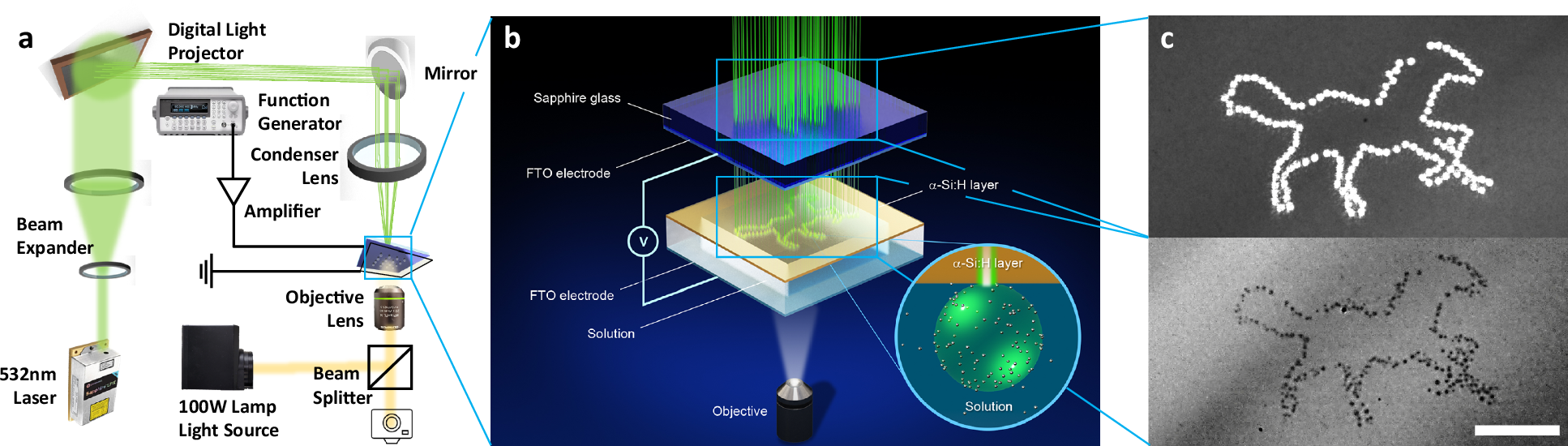
a Schematic of the DLP device used for large-area bubble patterning. b Close-up of the setup during bubble generation and subsequent particle patterning. c Laser pattern of a horse (top) and corresponding bubble pattern (bottom). Scale bar: 100 μm.
Microbubbles, gas-filled spheres only micrometers in size, have long been valued in medical imaging and drug delivery. But controlling them with precision and at scale has been a challenge, especially when trying to use them for delicate biological applications. This new method combines light-based projection with low-energy electrolysis to create microbubbles with exact sizes and positions, some as small as a few microns and others over 100 microns in diameter. Impressively, the system can achieve spatial accuracy of about 2 microns, roughly 1/50 the width of a human hair, using light intensities far lower than other photochemical techniques.
So what can you do with these tiny bubbles? The team showed they can use them to assemble organized patterns of a wide range of biological and nanotechnological materials. These included:
- 40-nanometer nanocrystals, useful in sensors and electronics
- 200-nanometer extracellular vesicles, which carry important biological signals
- Polymer nanospheres, often used in drug delivery
- Live bacterial cells, patterned for real-time response analysis
One of the most exciting applications demonstrated was the creation of nanosensor arrays composed of bacterial cells. These arrays allowed the researchers to monitor how bacteria responded to different metabolic conditions or antibiotics using spectroscopic profiling. This could pave the way for high-throughput antibiotic screening or personalized treatment approaches based on bacterial behavior.
The technology works at room temperature, with low energy input, and avoids harmful chemicals, making it highly suitable for biological samples. Because the bubbles are controlled using light and electricity, the system can be scaled up for large-scale manufacturing of bio-nano arrays, which could be used in everything from drug discovery to single-cell omics, bioseparation, and even building tiny components for nanorobotics.


