Exosome RNA Exosome RNA Research & Industry News


Extracellular vesicles are tiny membrane-bound particles released by cells. They can carry proteins, RNA, lipids, organelles, and other cellular material, allowing cells to communicate with one another or remove unwanted contents. For many years, most attention in the field has focused on small extracellular vesicles, including exosomes.
Researchers La Trobe Institute for Molecular Science, La Trobe University, discuss the growing importance of large extracellular vesicles. These vesicles are generally larger than 200 nanometers and include several biologically distinct subtypes that have gained increasing attention in recent years.
Mechanism of L-EV formation during distinct cellular fates or states
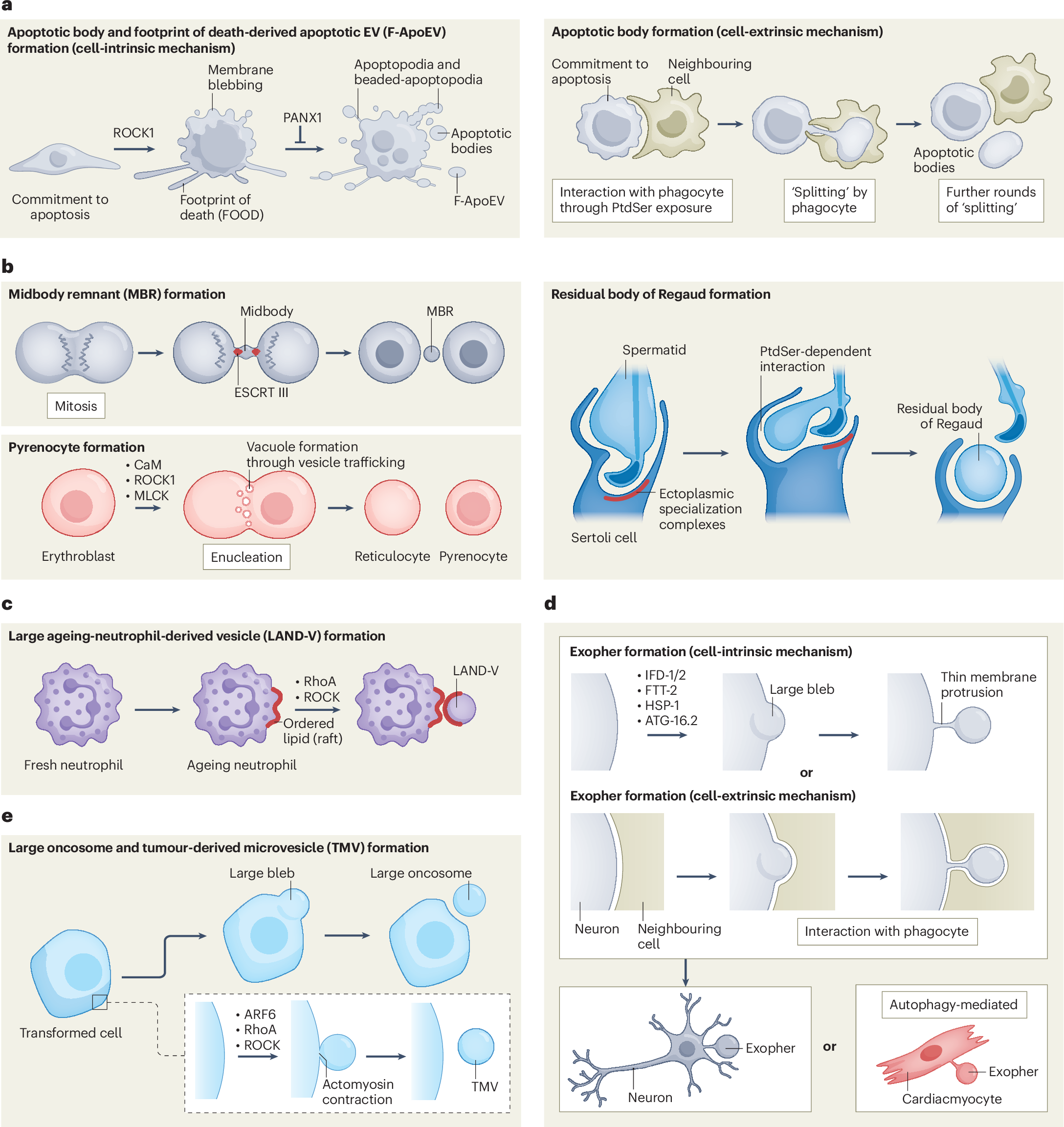
a, Cell death. Apoptotic cells undergo distinct morphological changes to generate apoptotic bodies and footprint of death (FOOD)-derived ApoEVs (F-ApoEVs). Formation of apoptotic bodies through these morphological changes is mediated through cell-intrinsic mechanisms and is not influenced by non-cell-autonomous factors. In contrast, healthy neighbouring cells can also aid the formation of apoptotic bodies by interacting and ‘splitting’ apoptotic cells apart (that is, a cell-extrinsic mechanism). b, Cell division and differentiation. MBRs are formed at the abscission sites during mitosis. As erythrocytes mature, the nucleus is enucleated to form a reticulocyte (which progresses to form a red blood cell) and pyrenocyte (harbouring all the nuclear contents for clearance). During the maturation of spermatids, the majority of the cytoplasm is removed by Sertoli cells as a residual body of Regaud. c, Cell ageing. LAND-Vs bud from ageing neutrophils. d, Cell stress. Under conditions of cellular stress, cells such as neurons and cardiomyocytes can release exophers harbouring aggregated proteins and organelles (for example, mitochondria). Exophers can be generated via cell-intrinsic mechanisms or through interaction with neighbouring phagocytes (that is, a cell-extrinsic mechanism). e, Cell transformation. Certain cancer cell types can form large oncosomes through a large membrane bleb, or release TMVs from the plasma membrane. It is of interest to note that (1) L-EV formation often begins with the formation of a large membrane bleb or from cell retraction, and (2) L-EV formation can be regulated by cell-intrinsic and/or cell-extrinsic mechanisms
Large extracellular vesicles are not simply bigger versions of small vesicles. They can form in different biological settings, carry different types of cargo, and perform different functions. Some are produced by dying cells, stressed cells, migrating cells, or cells undergoing specialized biological processes.
One important role of large extracellular vesicles is waste removal. Cells must safely dispose of damaged proteins, organelles, and other unwanted material. Large EVs can package this material and help clear it from tissues, supporting normal tissue maintenance and reducing harmful inflammation.
Large extracellular vesicles also help cells communicate. Because they can carry complex cargo, including signaling molecules and even cellular structures, they may influence nearby or distant cells. This makes them important in processes such as immune responses, tissue repair, cancer biology, and disease progression.
The researchers emphasize that large EV biogenesis depends heavily on context. In other words, the way these vesicles form depends on the type of cell, its condition, and the biological environment. A stressed cell, a dying cell, and a migrating cell may each produce different types of large EVs with distinct functions.
These vesicles may also have diagnostic and therapeutic potential. Because they can reflect the state of the cells that produce them, large extracellular vesicles could serve as biomarkers of disease or tissue damage. Their natural ability to transport cargo also makes them interesting candidates for therapeutic delivery.
However, the field still faces major challenges. Researchers need better ways to define, isolate, and study different large EV subtypes. Standardized methods will be essential for understanding their biology and for translating large EV research into clinical applications.
Overall, large extracellular vesicles are emerging as important players in cell biology. By studying how they form and what they do, researchers may uncover new mechanisms of cellular cleanup, communication, diagnosis, and treatment.