 Exosome RNA Exosome RNA Research & Industry News

Protein degradation plays a crucial role in maintaining cellular balance and function, and recent advancements are pushing the boundaries of how we can target and degrade extracellular proteins. MONOTAB (MOdified NanOparticle with TArgeting Binders), developed at Zhejiang University is a novel approach that overcomes several limitations of existing degradation methods.
The Challenge with Current Strategies
Existing methods for degrading extracellular proteins often use bifunctional chimeras, which are designed to direct proteins to lysosomes for breakdown. These chimeras rely on specific receptors on the cell surface to facilitate this process. However, this approach has its drawbacks. Variations in receptor expression among different cells or mutations in these receptors can lead to resistance. Moreover, these methods often struggle to adapt to different scenarios, making them less versatile.
Introducing MONOTAB: A Versatile Solution
MONOTAB offers a groundbreaking solution to these challenges. Unlike traditional methods, MONOTAB does not depend on specific lysosome-trafficking receptors. Instead, it leverages the natural lysosome-targeting ability of certain nanoparticles. This innovation eliminates the problem of receptor dependency and ensures more reliable protein degradation.
The concept of MONOTAB based on lysosome-targeting endocytosis of NPs
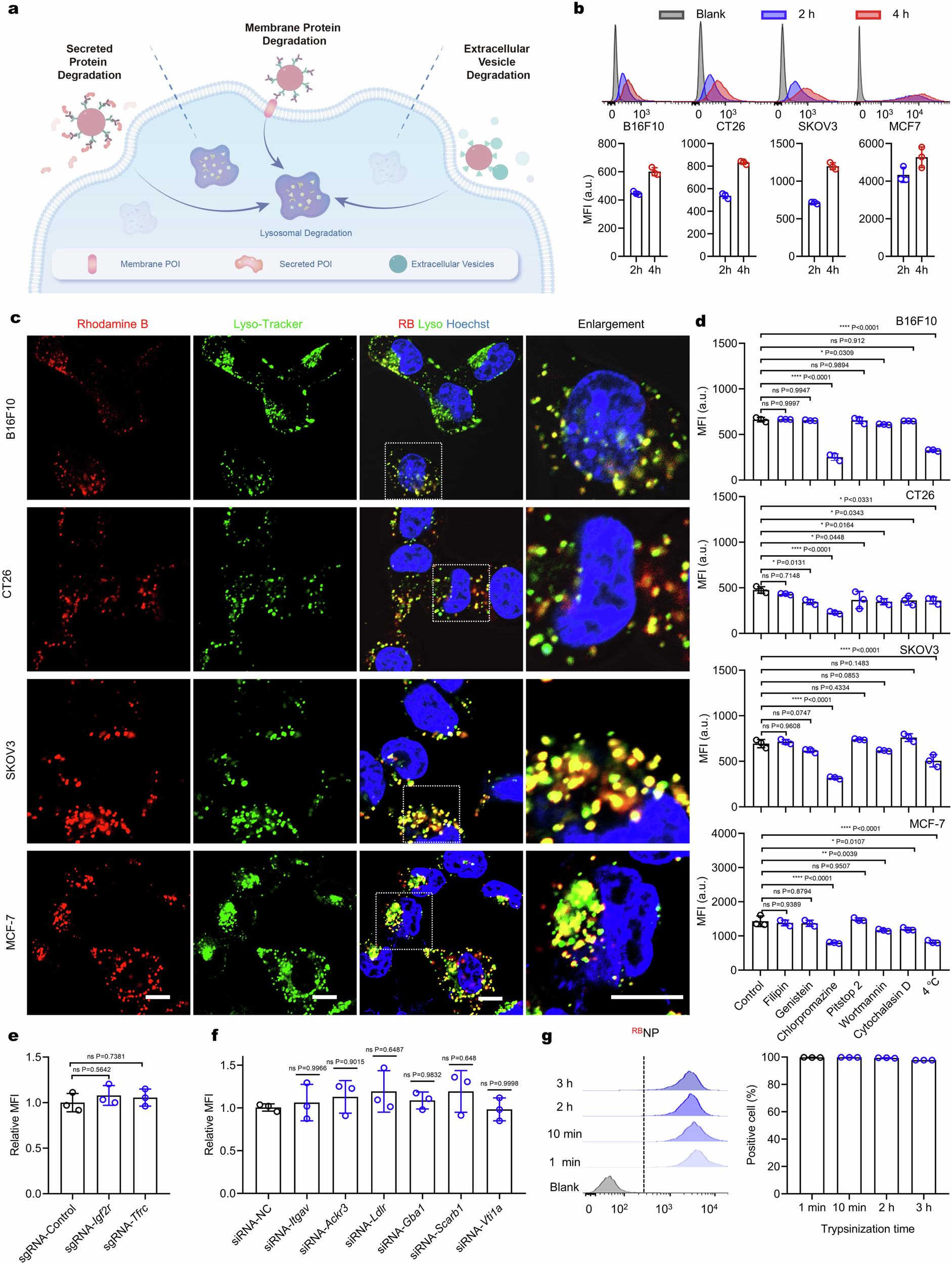
a Targeted degradation of extracellular proteins or vesicles mediated by MONOTABs. b Cellular uptake of rhodamine B-labeled NPs (RBNPs) after co-incubation with B16F10 cells for 2 or 4 h (n = 3 biologically independent experiments, each counting 10,000 cells). c Live-cell imaging of different cell lines treated with RBNPs (100 μg mL−1) for 4 h. Scale bar, 10 μm. The images are representative of n = 3 biological replicates. d Effects of endocytic inhibitors on cellular uptake of RBNPs in different cell lines in terms of the RB intensity measured by flow cytometry (n = 3 biologically independent experiments). e and f Cellular uptake of RBNPs (50 μg mL−1) after co-incubation with Igf2r- or Tfrc-KO B16F10 cells, or Itgav-, Ackr3-, Ldlr-, Gba1-, Scarb1- or Vti1a-silencing B16F10 cells for 2 h (n = 3 biologically independent experiments, each counting 10,000 cells). g Cellular uptake of RBNPs (50 μg mL−1) after co-incubation with B16F10 cells for 2 h. Cells were pre-treated with trypsin within 3 h (n = 3 biologically independent experiments, each counting 10,000 cells). Data are presented as mean ± SD where relevant. p values were determined by one-way analysis of variance (ANOVA) with Dunnett’s post hoc test. ns no significance; *p < 0.05; **p < 0.01; ***p < 0.001; ****p < 0.0001.
How MONOTAB Works
MONOTAB is designed as a “plug-and-play” platform, allowing for high flexibility and adaptability. It uses the well-known streptavidin-biotin interaction to attach antibodies or other targeting molecules to nanoparticles. This method enables precise targeting of various extracellular proteins, including membrane proteins, secreted proteins, and even extracellular vesicles.
Broad Applications and Efficiency
MONOTAB can effectively degrade a wide range of therapeutic targets, making it applicable in various research and clinical contexts. By bypassing the need for specific receptors and utilizing a modular design, MONOTAB promises a more universal and efficient approach to protein degradation.
MONOTAB’s ability to target and degrade extracellular proteins without relying on specific cell surface receptors opens up new possibilities for therapeutic development and research. As we continue to explore and refine these innovative strategies, MONOTAB stands out as a promising tool for overcoming current limitations and enhancing the effectiveness of protein degradation methods.


