 Exosome RNA Exosome RNA Research & Industry News

Researchers at the Macau University of Science and Technology have developed a new computational method that improves how scientists analyze extracellular vesicles (EVs), tiny particles released by cells that carry important biological information. Their approach, called MWENA (Meta-Weight Elastic Net Algorithm), could help researchers better detect disease-related patterns hidden in complex EV data.
Extracellular vesicles have become one of the most promising tools in modern diagnostics. They circulate in blood and other body fluids, carrying proteins, RNA, and other molecules that reflect the state of their parent cells. Because EVs are stable and easily collected through liquid biopsy, they offer a noninvasive way to monitor health, detect disease early, and even track how a patient responds to treatment.
However, analyzing EV data presents major challenges. The data are often “high-dimensional,” meaning there are far more measurable variables than actual samples, and the data can be noisy or unbalanced between different disease groups. Traditional machine learning models often struggle with this imbalance, missing key signals in smaller sample sets.
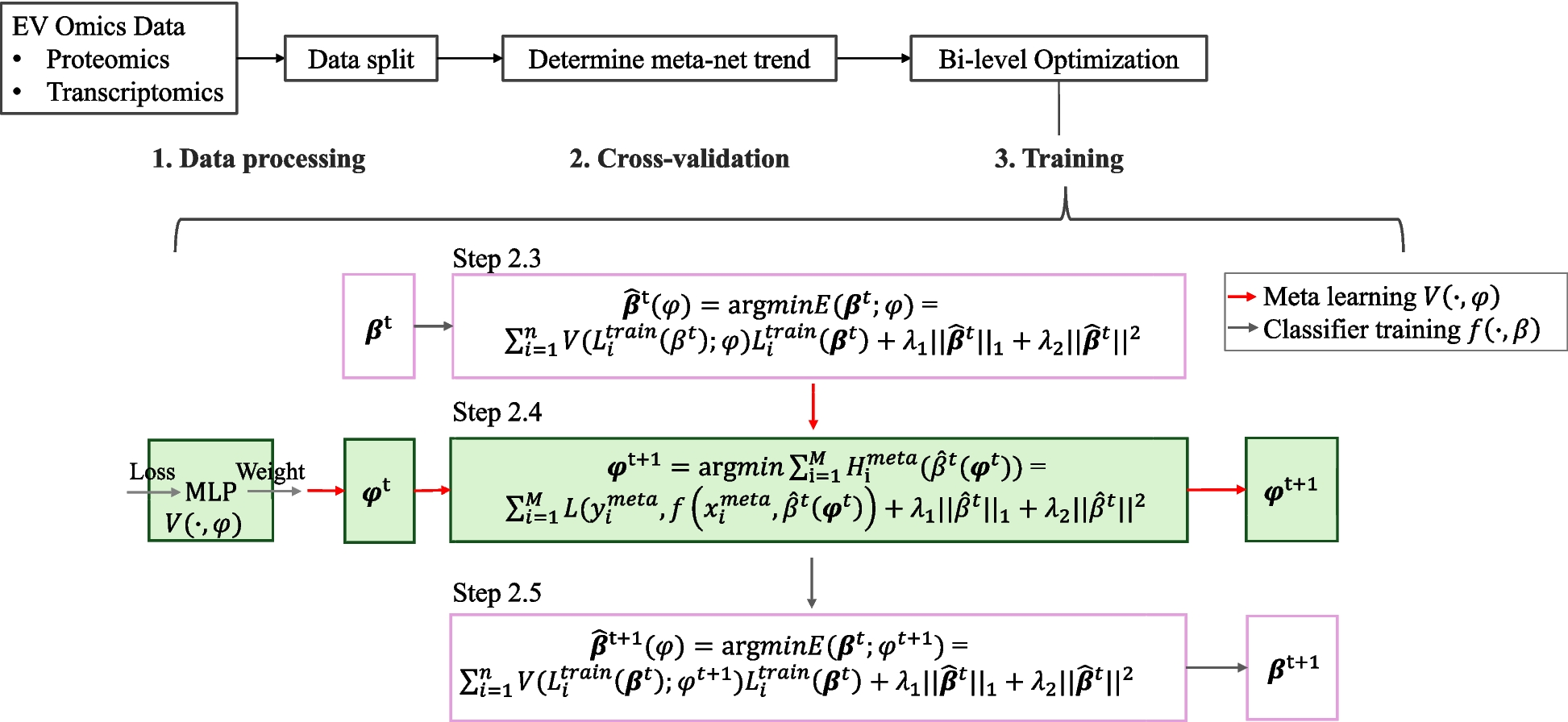
The MWENA algorithm addresses these issues by using elastic net regularization, a statistical approach that balances model simplicity and accuracy, combined with a meta-learning re-weighting function that automatically adjusts how much importance to give each sample. This allows the model to learn generalizable patterns even from uneven or limited data.
Overview of the MWENA
When tested on EV datasets across six classification tasks involving four diseases, pancreatic ductal adenocarcinoma, interstitial lung diseases, colorectal cancer, and ovarian cancer, MWENA consistently outperformed existing methods. It proved especially effective at identifying disease subtypes and early stages that are typically harder to detect.
Beyond improving accuracy, MWENA also highlighted specific EV signatures that may serve as potential biomarkers, giving researchers insights into the underlying biological processes of these diseases. This makes MWENA not only a useful diagnostic tool but also a way to better interpret complex biological data and identify new therapeutic targets.
As liquid biopsy technologies continue to expand, tools like MWENA will play a vital role in unlocking the diagnostic and research potential of extracellular vesicles—helping to turn raw molecular data into actionable medical knowledge.
Availability – All code and associated input data used in this research are available at https://github.com/ShuilinLiao/MWENA/tree/BMC.


