 Exosome RNA Exosome RNA Research & Industry News

Recent advances in cancer diagnostics have shown that messenger RNA (mRNA) found in extracellular vesicles (EVs) can provide critical insights into a patient’s cancer status. EVs are tiny particles released by cells that carry important molecular information, like mRNA, to other cells. By analyzing EV mRNA in liquid biopsies (which are blood tests), doctors can potentially detect key information about cancer, such as genetic mutations, treatment resistance, and whether a tumor is recurring. However, until now, EV mRNA hasn’t been used as much as it could be due to challenges in its detection—it exists in very small amounts in liquid biopsies, making it difficult to analyze without using large samples or complex methods.
Introducing SCOPE
To overcome these challenges, researchers at the Massachusetts General Hospital Research Institute have developed an innovative tool called SCOPE (Self-amplified and CRISPR-aided Operation to Profile EVs). This tool uses a powerful technology known as CRISPR, which is better known for its ability to edit DNA, to recognize and amplify specific target RNA molecules (like mRNA). The key here is that SCOPE dramatically increases the ability to detect even tiny amounts of EV mRNA, reaching detection levels that were previously impossible. It also ensures accuracy by detecting changes at the single-nucleotide level—important for identifying specific mutations in cancer cells.
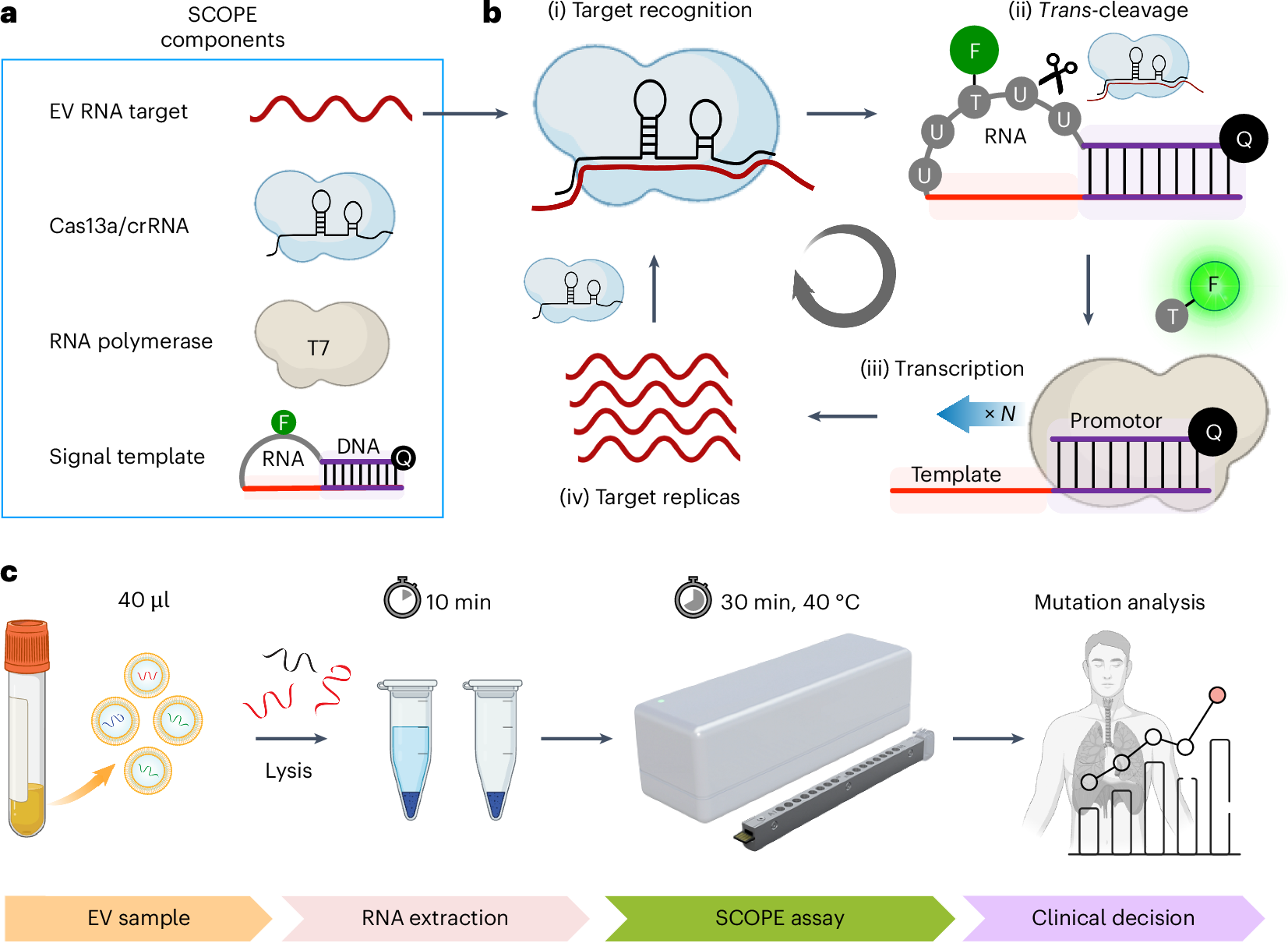
a, SCOPE mechanism. The assay couples Cas13a/crRNA and polymerase reactions through a signal template (bottom). The signal template contains an RNA segment with a quenched fluorescent dye and a DNA template for T7 polymerase. The fluorescent signal is initially quenched (F, fluorescent dye; Q, quencher). b, Assay flow. (i) Cas13a/crRNA first recognizes the EV RNA target, which activates its ribonuclease function. (ii) The activated enzyme cuts the RNA segment in the signal template, generating a fluorescent signal and exposing the DNA template. (iii) T7 RNA polymerase binds to the promoter region of the DNA template and synthesizes target RNA replicas. (iv) The amplified target replicas bind to free Cas13a/crRNA, enforcing the overall assay process. Note that the initial CRISPR-mediated target recognition is necessary to unlock RNA replication and signal generation. c, SCOPE workflow for onsite diagnostics. EVs are isolated from clinical samples and lysed. EV lysates are then placed in surface-treated tubes for RNA extraction (10 min). Subsequently, the SCOPE reaction is performed in a compact, portable device (30 min). The assay produces molecular information within 1 h, enabling same-day clinical decisions.
How Does It Work?
SCOPE’s approach combines CRISPR with a type of enzyme called Cas13, which identifies and binds to specific RNA sequences. Once the target mRNA is found, the system amplifies the signal, making it easier to detect even the smallest traces of mRNA in liquid biopsies. This process allows SCOPE to identify key cancer-related mutations with remarkable precision. For example, in this study, the researchers focused on mutations in genes like KRAS, BRAF, EGFR, and IDH1, all of which are commonly associated with various cancers.
Proof of Concept and Clinical Applications
As a proof of concept, the researchers developed probes to detect specific mutations in these cancer-related genes. They also optimized a method to run this detection process in a single-pot assay, which means the entire analysis happens in one step, simplifying the process. The team even designed an automated device to test multiple samples at once, making it more efficient for clinical use.
In testing, SCOPE was able to detect early-stage lung cancer in animal models and monitor tumor mutations in patients with colorectal cancer. Even more impressively, the system could help stratify (or categorize) patients with glioblastoma, a type of brain cancer, based on their genetic profiles.
Why Is This Important?
The ability to quickly and accurately detect cancer-related mutations from liquid biopsies is a game-changer in precision oncology—the personalized approach to cancer treatment. With tools like SCOPE, doctors can potentially catch cancer earlier, monitor how it evolves in response to treatment, and tailor therapies to target specific genetic mutations. This could mean faster, more effective treatments for cancer patients, and improved outcomes overall.
In summary, SCOPE is poised to revolutionize how we use extracellular vesicles in cancer diagnostics. By providing a powerful new method to detect cancer-related mutations from liquid biopsies, it brings us one step closer to more personalized, targeted cancer care.


