 Exosome RNA Exosome RNA Research & Industry News

At the University of Oulu in Finland researchers have uncovered how tiny biological “packages” in our gut may carry important clues about cancer. These packages, called extracellular vesicles (EVs), are released by cells and contain molecular cargo like proteins, fats, and metabolites. In the gut, EVs can come from both human cells and bacteria, making them a unique snapshot of our health, and potentially of disease.
While most research on EVs in cancer has focused on blood, urine, or saliva, Mishra’s team turned their attention to EVs found in stool samples. They analyzed fecal EVs from patients with solid tumors and compared them to those from healthy individuals using a technique called liquid chromatography–mass spectrometry (LC-MS), which can detect and measure tiny amounts of metabolites.
Visualization of fecal extracellular vesicle (EV) metabolome
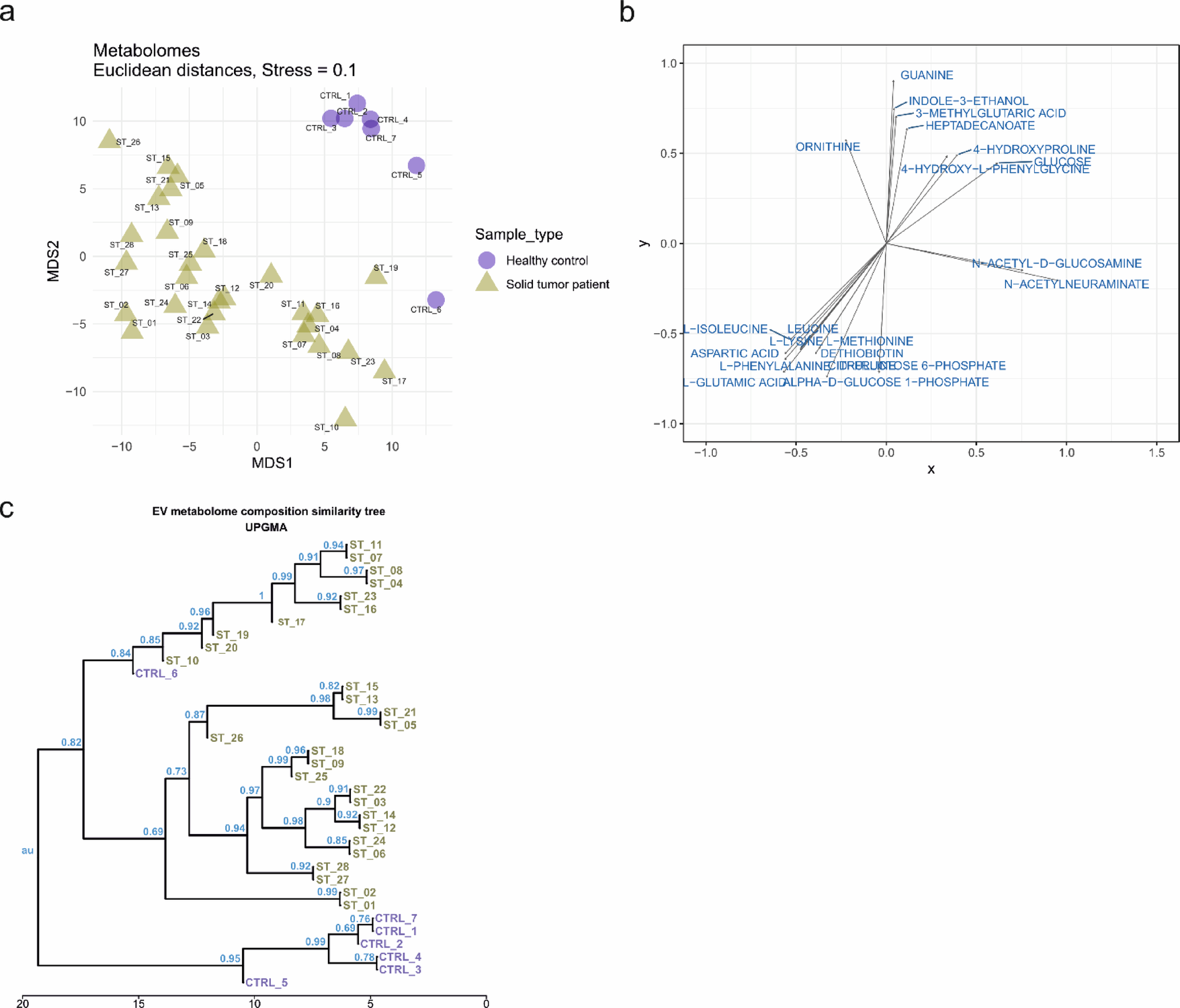
(a) Non-metric Multi-Dimensional Scaling (nMDS) ordination based on the Euclidean distance matrix, depicting the differences in the fecal EV metabolome between healthy controls and patients with solid tumors. (CTRL: Healthy controls; ST: Patients with solid tumors) (b) Plot depicting the metabolites with abundances significantly changing in the multidimensional space of analyzed samples and arrows showing the direction of abundance increase (c) Metabolome similarity tree constructed using Unweighted Pair Group Method with Arithmetic Mean (UPGMA) based on the Euclidean distance matrix (CTRL: Healthy controls; ST: Patients with solid tumors).
They discovered distinct differences in the metabolic makeup of the fecal EVs between cancer patients and healthy controls. For example, L-glutamic acid was much higher in cancer patients, while guanine and N-acetylneuraminate were lower. These metabolic changes were linked to key biological pathways involved in amino acid and fatty acid production.
One particularly striking finding was that glutamic acid could reliably distinguish cancer patients from healthy people, suggesting it might serve as a potential biomarker. Some of these metabolites may even have bacterial origins, highlighting the important role of the gut microbiome in cancer biology.
By studying fecal EVs, researchers are opening the door to new, non-invasive ways of monitoring cancer and understanding how our gut microbes interact with disease, potentially improving diagnosis, prognosis, and treatment strategies in the future.


