Exosome RNA Exosome RNA Research & Industry News

Extracellular vesicles, often called exosomes, are naturally released particles that cells use to communicate with each other. Because they are made by cells and are generally well tolerated by the body, they have attracted strong interest as potential drug delivery vehicles. In theory, they could carry therapeutic cargo directly to specific tissues while avoiding some of the safety issues seen with synthetic nanoparticles.
Researchers at the University of North Carolina at Chapel Hill take a broad look at why this promise has not yet translated into approved therapies. They examine more than 38,000 research articles published between 2012 and 2024, along with over 100 clinical trials that have explored extracellular vesicles as treatments or drug carriers.
Despite intense research activity, several challenges continue to slow progress. Extracellular vesicles are highly heterogeneous, meaning vesicles from the same cell source can differ widely in size, composition, and function. Producing them at scale remains difficult, loading drugs efficiently is often inconsistent, and many vesicles are rapidly cleared by the immune system before they reach their target.
Clinical research on therapeutic EVs
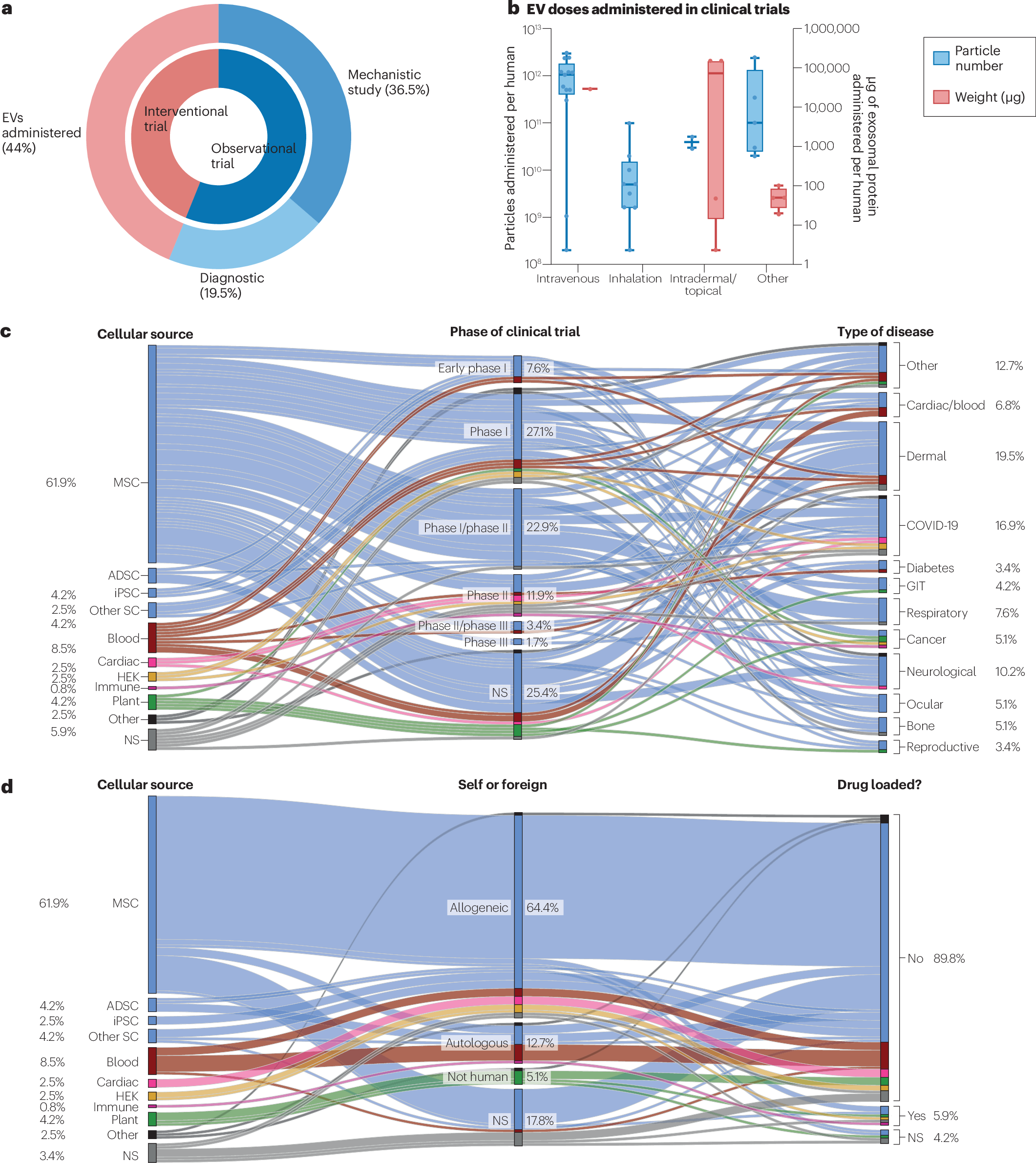
a, Overview of 338 clinical studies categorized by study aim. b, Dose ranges administered to patients reported either by particle number or weight. c, Alluvial plot displaying extracellular vesicle (EV)-based therapies in clinical studies, showcasing the relationship between cell sources, their use in clinical trials from early phase I to phase III and their applications across different diseases. d, Alluvial plot illustrating the relationship between cell sources used for EV production, indicating whether the EVs are allogeneic, autologous or of non-human origin, and whether they have been loaded with therapeutic cargo. ADSC, adipose-derived stem cell; GIT, gastrointestinal tract; HEK, human embryonic kidney; iPSC, induced pluripotent stem cell; MSC, mesenchymal stem cell; NS, not specified; SC, stem cell.
The researchers also compare extracellular vesicles with other delivery systems such as lipid nanoparticles and liposomes. While EVs offer advantages in biological compatibility and targeting potential, synthetic systems currently outperform them in terms of manufacturing consistency and regulatory readiness. The researchers highlight how choices such as cell source, labeling strategy, and administration route strongly influence where vesicles travel in the body.
Importantly, they emphasize that translation is not blocked by science alone. Regulatory expectations, inconsistent reporting standards, and gaps in biodistribution data all contribute to the slow pace of clinical approval. To address this, the authors propose additional reporting guidelines to complement the MISEV 2023 standards, aiming to improve reproducibility and comparability across studies.