 Exosome RNA Exosome RNA Research & Industry News

Salmonella is one of the most common causes of foodborne illness worldwide, leading to serious infections that are becoming harder to treat as antibiotic resistance grows. While vaccines exist for Salmonella Typhi (the cause of typhoid fever), there are no approved vaccines for non-typhoidal Salmonella (NTS), which are responsible for many cases of illness and death.
Researchers at the University of Florida have been exploring a new way to prevent these infections: using tiny particles called extracellular vesicles (EVs). These vesicles, released from infected immune cells, can carry bits of bacteria that “train” the immune system to recognize and fight off Salmonella.
In earlier work, the team showed that nasal delivery of EVs could protect mice from deadly Salmonella infections. Now, they have taken it a step further by testing an oral vaccine approach. Mice that received EVs by mouth showed higher survival rates after exposure to Salmonella and had fewer bacteria in their organs. Even more encouraging, the mice developed strong immune responses, producing antibodies that specifically recognized Salmonella proteins.
Preventive efficacy of orally administered sEVs from,
Salmonella-infected macrophages against salmonellosis
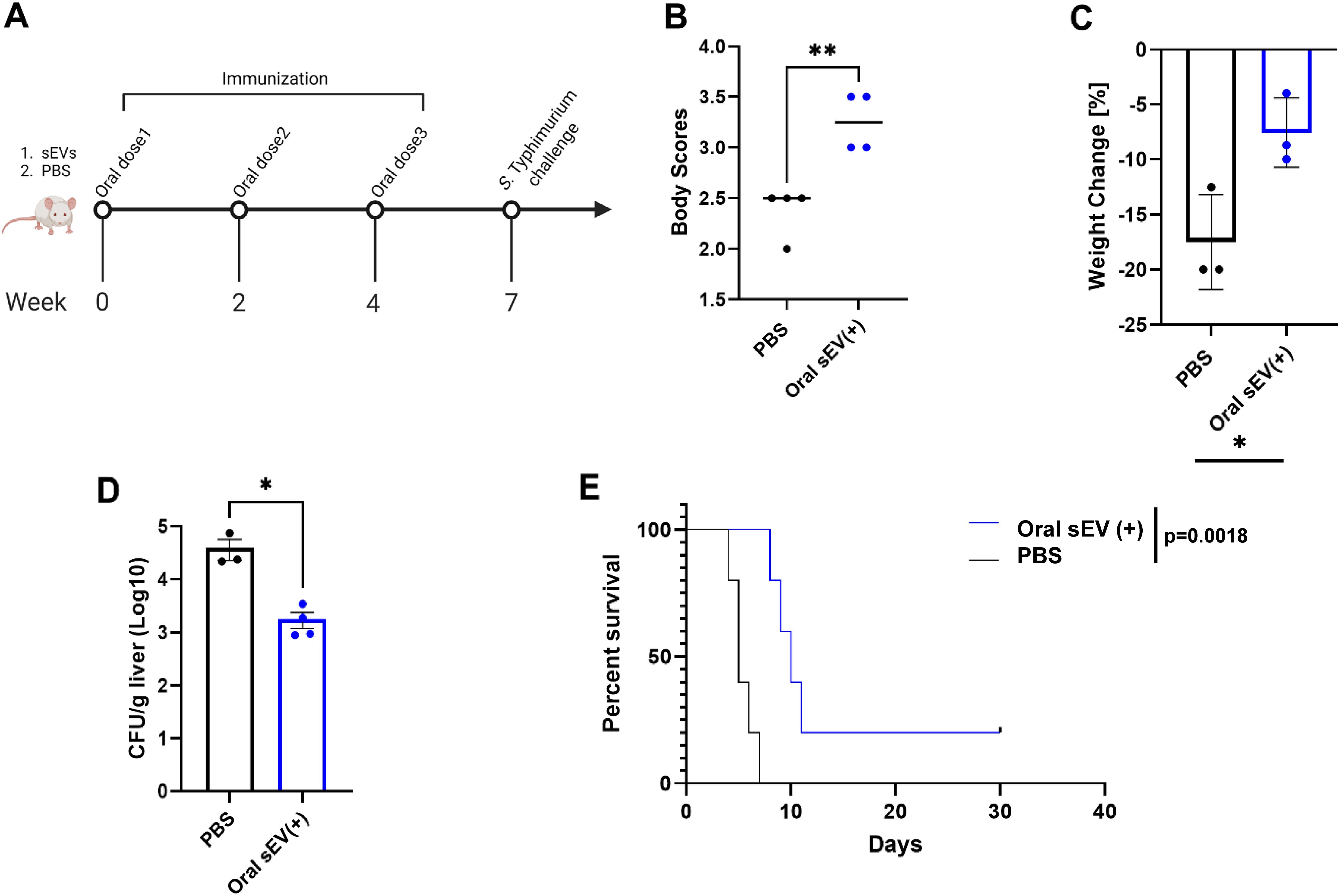
BALB/c mice were orally immunized with three doses of sEVs (40 µg per dose), or PBS at two-week intervals. Three weeks after the final dose, mice were challenged orally with virulent S. Typhimurium. (A) Immunization and challenge timeline. (B) Clinical disease scores based on body condition assessments on day 4 post-challenge (n=4). Unpaired parametric t-test used for analysis. (C) Percent body weight change on day 4 post-challenge (n=3). Unpaired parametric t-test used for analysis. (D) Bacterial burden in the liver (CFU/g) four days post-challenge. Unpaired parametric t-test used for analysis. (E) Kaplan–Meier survival curves over 30 days post-challenge (n=5). Results are denoted with * for p-value at <0.05, ** at <0.01.
These findings suggest that EVs could serve as the basis for a cell-free, oral vaccine platform, offering protection where the body is most vulnerable: in the gut. If successful in further testing, this approach may one day help reduce the global burden of Salmonella infections.


