 Exosome RNA Exosome RNA Research & Industry News

Triple-negative breast cancer, or TNBC, is an aggressive form of breast cancer that lacks several of the molecular targets used to treat other breast cancer subtypes. Although TNBC can trigger strong immune responses, tumors also develop ways to weaken or redirect immune cells.
One potential mechanism involves exosomes, small extracellular vesicles released by cells that carry proteins, RNA, and other molecules. Tumor-derived exosomes can travel to immune cells and alter how those cells behave.
A research team from the Department of Medicine at Indiana University, investigated how exosomes released by TNBC cells influence human T cells.
Schematic overview of the multi-omic framework to assess
TNBC exosome-mediated T cell modulation
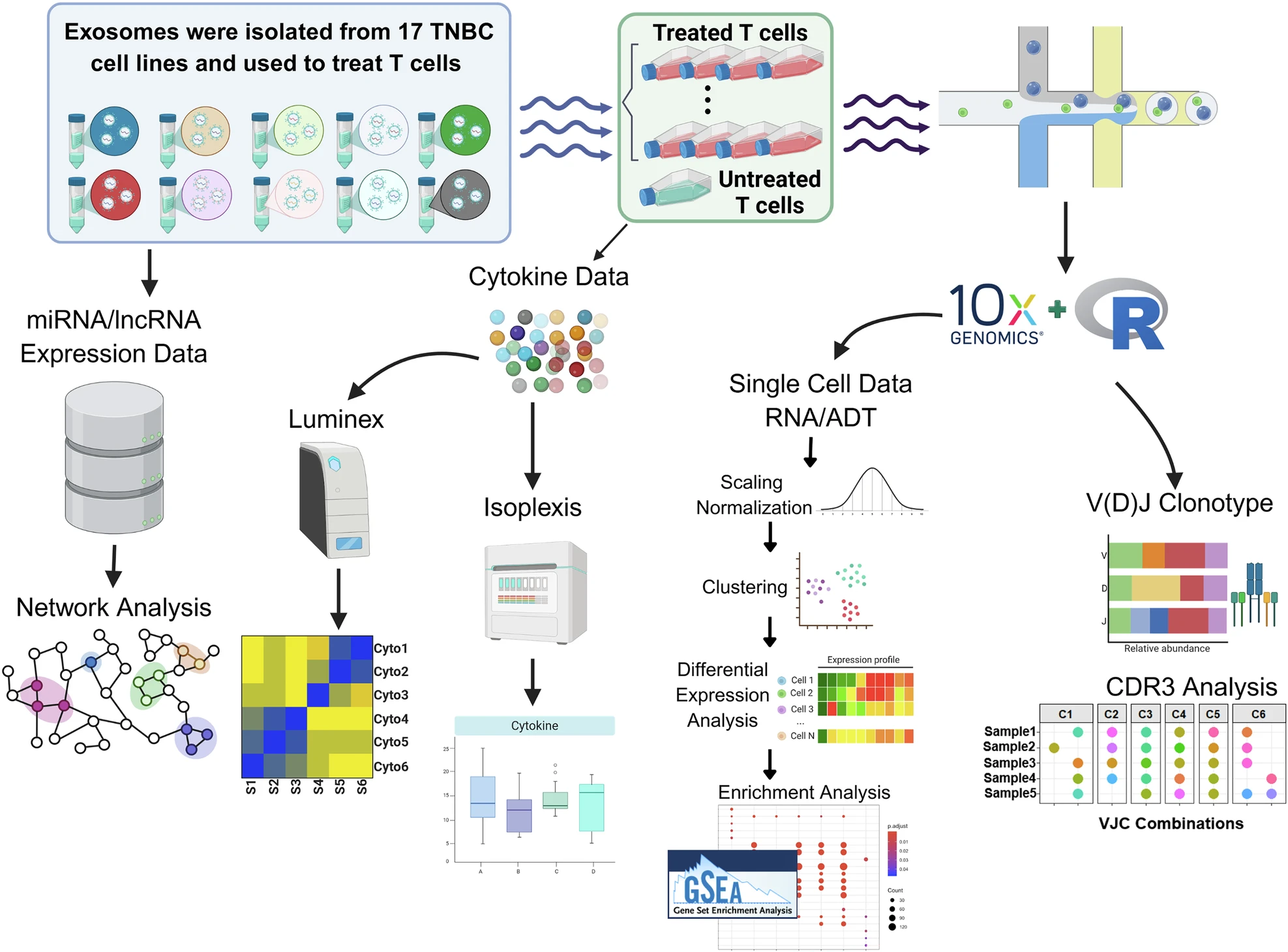
Exosomes were isolated from 17 molecularly distinct TNBC cell lines and used to treat primary human T cells; untreated T cells served as mock controls. Following exposure, single-cell RNA and surface protein (ADT) profiling, as well as T cell receptor (TCR) V(D)J sequencing, were performed using the 10x Genomics platform. Transcriptomic data underwent normalization, clustering, differential expression, and pathway enrichment analysis. TCR clonotype data were analyzed for CDR3 sequence and V-J-C gene usage to identify tumor-associated T cell expansions. In parallel, exosomal miRNA and lncRNA expression profiles were used for regulatory network analysis. Functional cytokine responses were assessed using Luminex and IsoCode single-cell cytokine analysis chips, highlighting exosome-driven immune modulation
Examining T cells one cell at a time
The researchers exposed primary human T cells to exosomes collected from 17 genetically diverse TNBC cell lines and samples from 35 patients.
They then used several advanced sequencing approaches, including single-cell RNA sequencing, T cell receptor sequencing, and noncoding RNA analysis, to determine how individual T cells responded.
Single-cell RNA sequencing was particularly useful because T cells are not a uniform population. Different T cell types perform different immune functions, and even cells of the same type can exist in different activation or functional states.
By examining cells individually, the researchers could identify changes that might be hidden if all T cells were analyzed together.
Exosomes push some T cells toward less effective states
Exposure to TNBC-derived exosomes changed the types of T cell states observed by the researchers.
Some T cells shifted toward regulatory or dysfunctional phenotypes, including regulatory T cells, Th17-like cells, and T follicular helper cells expressing immune checkpoint molecules such as PD-1 and PD-L1.
These changes are potentially important because effective anti-tumor immunity depends on T cells becoming activated and attacking cancer cells. The researchers found that exosome-treated cells showed reduced levels of early activation markers and weaker cytokine responses.
However, the effects were not identical across every type of T cell. Certain immune cell populations, including gamma delta T cells and natural killer T cells, retained some of their cytotoxic characteristics.
This suggests that tumor-derived exosomes may selectively suppress or redirect particular parts of the immune response rather than simply shutting down all T cell activity.
MicroRNAs carried by exosomes may alter immune genes
The researchers also examined small regulatory RNAs carried by the exosomes.
MicroRNAs, or miRNAs, are short RNA molecules that can reduce the expression of specific genes. Because exosomes can transport miRNAs between cells, tumor cells may use them as molecular messages that influence surrounding immune cells.
The analysis identified widespread reductions in immune-related gene activity after T cells were exposed to TNBC exosomes. Some of these changes were associated with regulatory miRNAs delivered by the exosomes, including miR-98-5p.
Genes affected included HBEGF and TNFSF9, which are involved in immune signaling and T cell activity.
These results suggest that exosomes may help TNBC cells reshape immune responses by delivering regulatory RNA directly to T cells.
Exosomes also change the T cell receptor repertoire
One of the most interesting findings involved T cell receptors, or TCRs.
Each T cell carries a receptor that recognizes particular molecular targets. When a T cell encounters a target it recognizes, that specific cell can multiply, creating a population of cells with the same TCR. This process is known as clonotypic expansion.
The researchers found distinct T cell clones after exposure to TNBC-derived exosomes.
Five tumor-specific gamma delta TCR clonotypes and 30 unique alpha beta TCR sequences appeared in exosome-treated cells but were absent from untreated controls.
This indicates that tumor-derived exosomes may influence not only whether T cells become activated or suppressed, but also which T cell populations expand.
Understanding exosome-driven immune remodeling
Tumors exist within a complex environment containing cancer cells, immune cells, blood vessels, and many other cell types. Communication between these cells can strongly influence whether the immune system successfully recognizes and attacks a tumor.
The findings suggest that extracellular vesicles are an important part of that communication in triple-negative breast cancer. TNBC-derived exosomes can deliver regulatory RNAs, alter T cell gene expression, change immune cell states, and influence the T cell receptor repertoire.
Understanding these interactions could eventually help researchers identify ways to prevent tumor exosomes from suppressing beneficial immune responses. It may also reveal T cell populations or exosomal molecules that could serve as biomarkers or potential therapeutic targets.


