 Exosome RNA Exosome RNA Research & Industry News

The Korea Food Research Institute (KFRI) recently released results on the growth regulation mechanisms among microbial groups of Akkermansia muciniphila, a top candidate for microbiome-based therapeutics.
A. muciniphila is abundant in the gut microbiota of healthy individuals and plays a critical role in maintaining homeostasis by modulating immune function and insulin sensitivity.
A research team led by Dr. Young-Do Nam at KFRI, in collaboration with Professor Kwang-Soon Kim at POSTECH and KFRI’s partner company EnteroBiome Co. conducted a large-scale analysis of gut microbiome data from Korean individuals. They discovered that A. muciniphila is not a single species but consists of four distinct subtypes (A. muciniphila clades I–IV) and that only one subtype is typically present in each individual.
Diversity of A. muciniphila influenced by urbanization
and single clade predominance in human populations
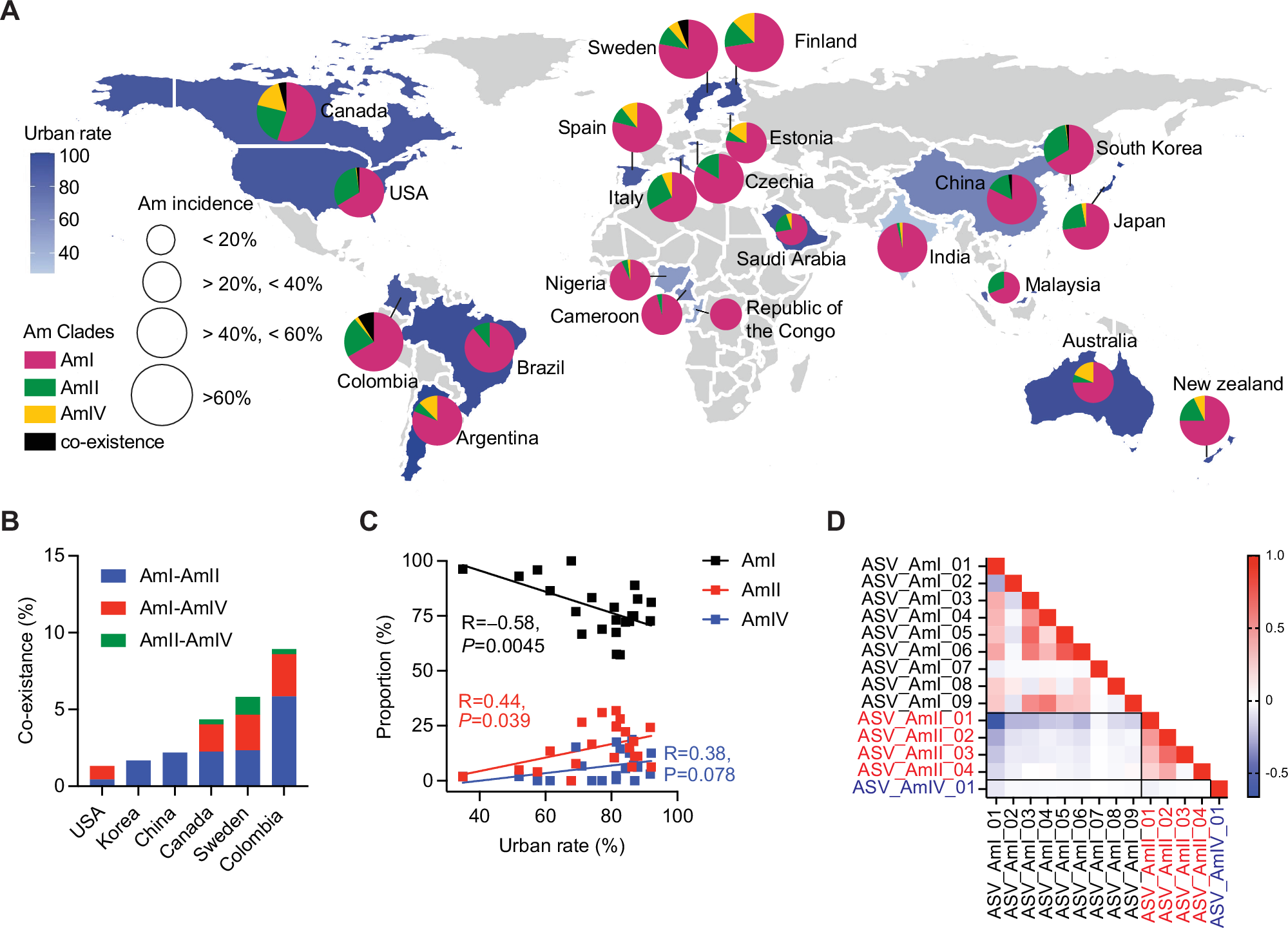
A Pie charts showing the distribution of A. muciniphila clades within each country. The blue scale filling each country represents the urban rate. The size of the pie reflects the proportions of individuals harboring A. muciniphila in each country. B Coexistence of A. muciniphila clades in six countries. C Scatter plot with Pearson correlation coefficients after two-sided multiple comparisons showing the correlation between the proportion of A. muciniphila clades and urbanization rate. D Spearman correlation matrix of A. muciniphila ASVs according to clade in 890 healthy Korean subjects. Spearman correlation coefficient strength was 12 as indicated by the colored bar. Twenty-two A. muciniphila ASVs were named for each clade according to the rank of total read count, and 14 ASVs with > 1000 read count were used for correlation analysis (ASV_AmI_01 to ASV_AmI_09: black, ASV_AmII_01 to ASV_AmII_04: red, ASV_AmIV_01: blue).
Based on these findings, the researchers hypothesized that different A. muciniphila subtypes compete with one another. To test this hypothesis, they performed comparative genomic and physiological analyses, in vitro co-culture experiments, and gnotobiotic experiments in germ-free mice.
Their results revealed that A. muciniphila clade II (AmII), which has limited ability to utilize mucin, can selectively eliminate its competitor, A. muciniphila clade I (AmI), which is known for its superior mucin utilization, thereby securing its colonization within the gut.
More specifically, AmII was found to secrete extracellular vesicles containing proteins that selectively target and lyse AmI cells. These vesicles disrupt the cell walls of AmI, effectively removing them.
Furthermore, extracellular vesicles from AmII enhance AmII colonization in the host through the induction of AmII-specific IgA antibody responses.
This discovery highlights a novel growth regulation strategy, whereby specific Akkermansia groups inhibit competing groups, either directly or indirectly, via extracellular vesicles. This suggests that certain subtypes of A. muciniphila have evolved to selectively eliminate competitors as an adaptive strategy to overcome disadvantages in nutrient acquisition.
Dr. Young-Do Nam from KFRI states, “By elucidating the competitive dynamics among A. muciniphila subtypes based on large-scale gut microbiota data from Koreans, our research could contribute to the development of precision dietary interventions aimed at selectively modulating specific A. muciniphila subtypes.”


